
Investigating Exponential Functions by Narzik
Loading the math board and drawing, please wait…
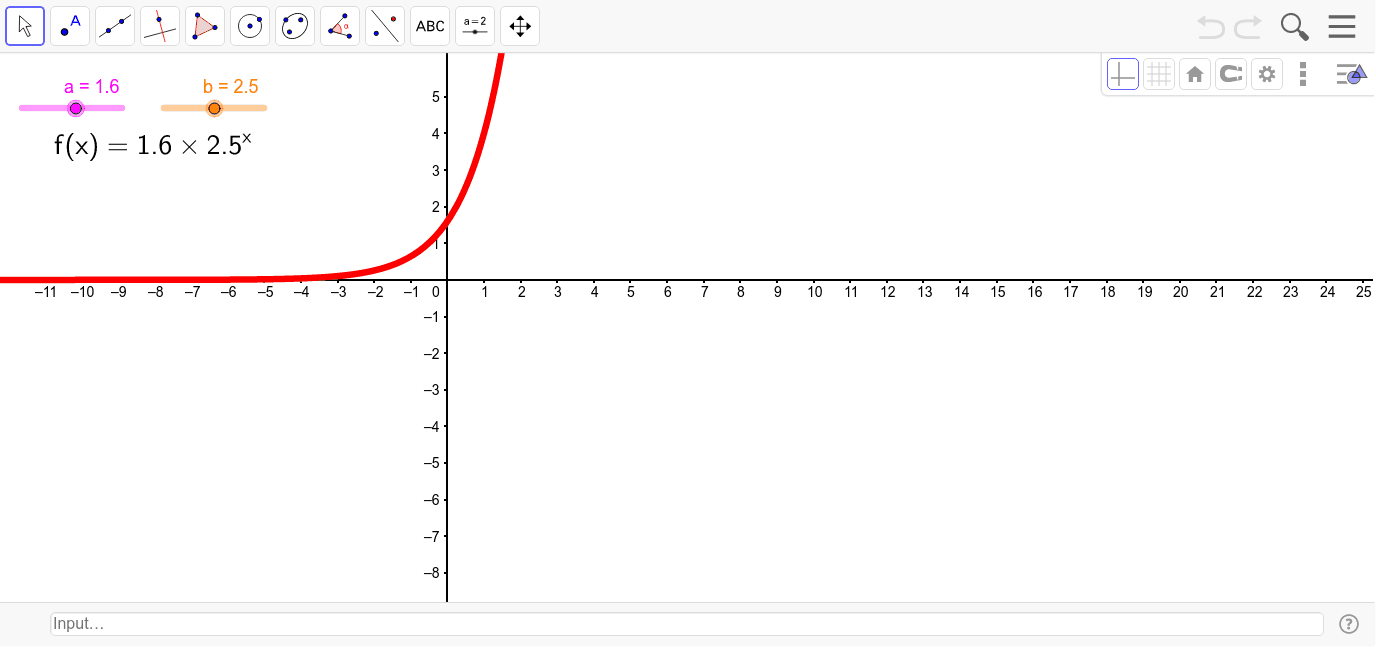
① This GeoGebra example dynamically explores the graph of an exponential function f(x)=a·b^x by adjusting parameters a and b, revealing growth/decay behavior, the fixed point (0,a), and horizontal asymptotes. ② Core mathematical concepts include exponential functions, transformations of function graphs, the geometric meaning of base and coefficient, and the connection to differential calculus through difference quotients and slopes, with extensions to complex numbers and 2D vectors. ③ Construction highlights: from the summary, objects a and b serve as adjustable parameters, f is the exponential expression, and multiple text objects (text1–text5) display dynamic values such as function outputs, slopes, or coordinates; these are linked via GeoGebra's algebra and graphics views for real-time updates. ④ Suitable for high school to pre-university students learning exponential functions, graphing, and introductory derivatives, as well as for AP Calculus or IB Mathematics classroom demonstrations and self-study.
GeoGebra Commands & Parameters
Numeric a(1.6)Numeric b(2.5)f(x) = (a * b^(x))