
Investigating Congruent Polygons 2.1
Loading the math board and drawing, please wait…
In collections
Butterflies, Pinwheels, and Wallpaper
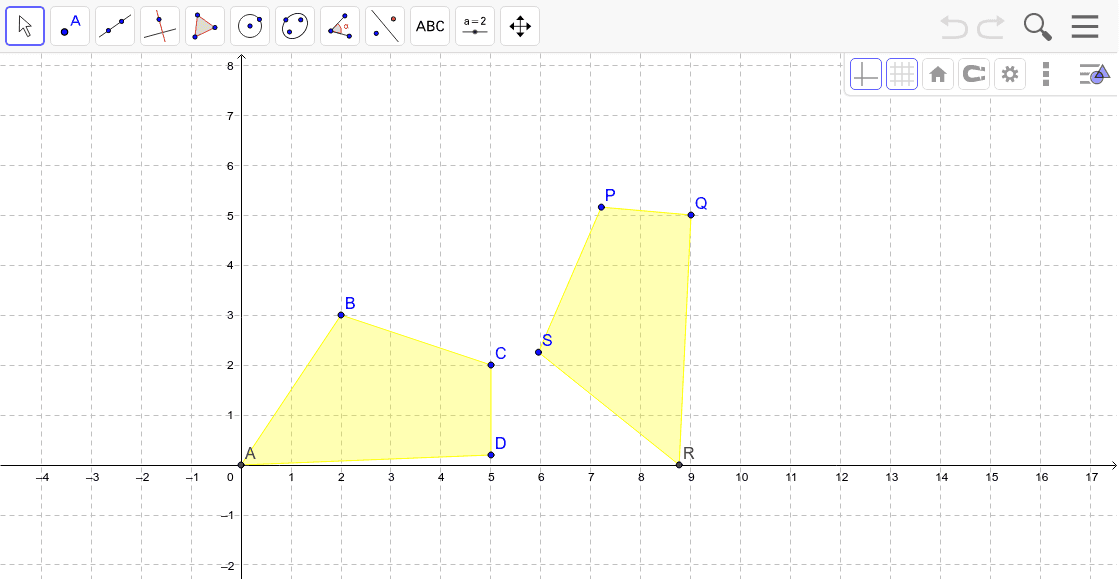
This example demonstrates how to construct congruent polygons using rotation and translation. Key mathematical concepts include congruence, polygons, and geometric transformations. Using GeoGebra commands such as Intersect, Polygon, Rotate, Vector, and Translate, a series of congruent polygons can be constructed. Suitable for middle school and above students learning geometric transformations.
GeoGebra Commands & Parameters
Intersect(xAxis, yAxis) → APolygon(A, B, C, D) → poly1, a, b, c, dRotate(A, 85*°, F) → A'Rotate(B, 85*°, F) → B'Rotate(C, 85*°, F) → C'Rotate(D, 85*°, F) → D'Polygon(A', B', C', D') → poly1', a', b', c', d'Vector(D', E) → uTranslate(E, u) → E'Vector(D', E) → vTranslate(A', v) → RTranslate(B', v) → STranslate(C', v) → PTranslate(D', v) → QPolygon(R, S, P, Q) → poly1'', a'', b'', c'', d''
AI Drawing Prompt Reference
Draw a figure consisting of four congruent polygons. Each polygon is formed by four points that are obtained through rotation and translation. The rotation angle is 85 degrees, and the translation vector is determined by the vector from one point to another. Ensure that the polygons maintain a symmetric relationship, and the overall figure follows the pattern of geometric transformations.
The prompt above was compiled from the original drawing commands and is for reference only.