
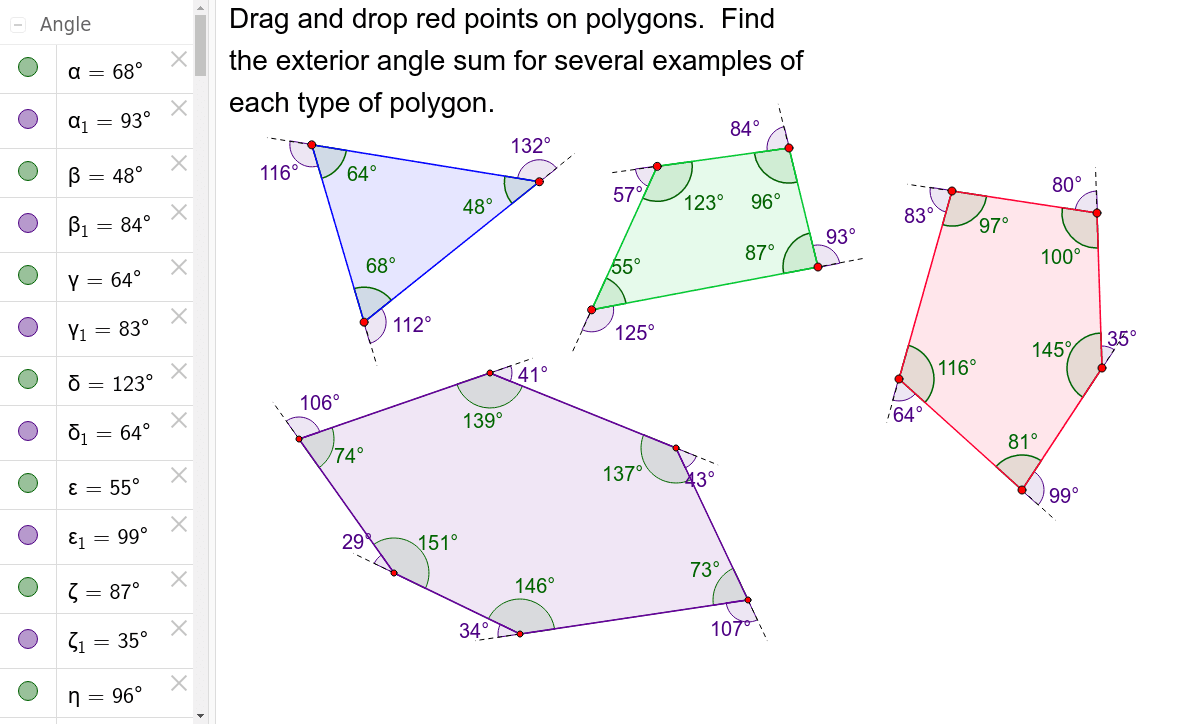
Investigate the sum of exterior angles in polygons
Loading the math board and drawing, please wait…
In collections
Angles in polygons
This example allows users to create polygons with varying exterior and interior angles by moving points. It demonstrates the fundamental concept that the sum of exterior angles of any polygon is always 360 degrees. Key math concepts include angles, polygons, and geometric constructions. GeoGebra commands used are Polygon, Angle, Segment, and Vector. Suitable for middle school students and above for visualizing and understanding polygon properties.
GeoGebra Commands & Parameters
Polygon(A, B, C) → poly1, c, a, bPolygon(D, E, F, G) → poly2, d, e, f, gPolygon(H, I, J, K, L) → poly3, h, i, j, k, lAngle(I, H, L) → θAngle(H, L, K) → ιAngle(L, K, J) → κAngle(K, J, I) → λAngle(J, I, H) → μSegment(M, N) → mSegment(N, Q) → nSegment(Q, O) → pSegment(O, R) → qSegment(R, P) → rSegment(P, M) → sPolygon(M, N, Q, O, R, P) → poly4, m_1, n_1, q_1, o, r_1, p_1Angle(P, M, N) → νAngle(M, N, Q) → ξAngle(N, Q, O) → οAngle(Q, O, R) → ρAngle(O, R, P) → σAngle(R, P, M) → τVector(A, B) → uSegment(B, S) → tVector(B, C) → vSegment(C, T) → a_1Vector(C, A) → wSegment(A, U) → b_1Angle(S, B, C) → υAngle(T, C, A) → ϕAngle(U, A, B) → χVector(D, E) → zVector(E, F) → u_1Vector(F, G) → v_1Vector(G, D) → w_1Segment(V, E) → c_1Segment(D, A_1) → d_1Segment(W, F) → e_1Segment(Z, G) → f_1Angle(V, E, F) → ψAngle(W, F, G) → ωAngle(Z, G, D) → α_1Angle(A_1, D, E) → β_1Vector(H, I) → z_1Vector(I, J) → g_1Vector(J, K) → h_1Vector(K, L) → i_1Vector(L, H) → j_1Vector(M, N) → k_1Vector(N, Q) → l_1Vector(Q, O) → s_1Vector(O, R) → t_1Vector(R, P) → u_2Vector(P, M) → v_2Segment(H, F_1) → a_2Segment(I, B_1) → b_2Segment(J, C_1) → c_2Segment(K, D_1) → d_2Segment(L, E_1) → e_2Segment(M, G_1) → f_2Segment(N, H_1) → g_2Segment(Q, I_1) → h_2Segment(O, J_1) → i_2Segment(R, K_1) → j_2Segment(P, L_1) → k_2Angle(F_1, H, I) → γ_1Angle(B_1, I, J) → δ_1Angle(C_1, J, K) → ε_1Angle(D_1, K, L) → ζ_1Angle(E_1, L, H) → η_1Angle(N, M, G_1) → θ_1Angle(Q, N, H_1) → ι_1Angle(O, Q, I_1) → κ_1Angle(R, O, J_1) → λ_1Angle(P, R, K_1) → μ_1Angle(M, P, L_1) → ν_1Angle(C, B, A) → αAngle(A, C, B) → βAngle(B, A, C) → γAngle(F, E, D) → δAngle(G, F, E) → εAngle(D, G, F) → ζAngle(E, D, G) → η
AI Drawing Prompt Reference
Draw a polygon with adjustable exterior and interior angles by moving its vertices, demonstrating that the sum of exterior angles of any polygon is always 360 degrees. Start by creating three polygons with different numbers of sides, labeling each exterior angle at the vertices. Then draw a hexagon and label its exterior angles. Next, draw a line segment and use it to construct another hexagon, labeling its exterior angles. Finally, add arrows to the sides of the first polygon and to the vertices of the second polygon to illustrate the rotational nature of the exterior angle sum.
The prompt above was compiled from the original drawing commands and is for reference only.