
Introduction to Quadratic Function: Parabola Match Activity
Loading the math board and drawing, please wait…
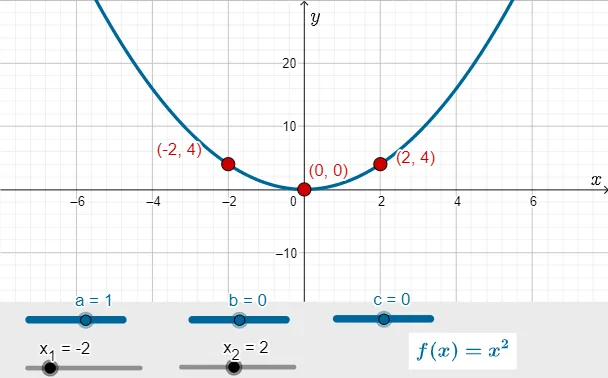
① This example demonstrates the basic shape and properties of a quadratic function's graph (a parabola) through a parabola matching activity, providing an intuitive introduction for beginners. ② Core mathematical concepts include the standard form f(x)=ax²+bx+c, the direction of opening, vertex, axis of symmetry, and how coefficients a, b, c affect the graph. ③ Construction highlights: from the construction summary, GeoGebra commands such as Simplify, Extremum, and Corner are used, along with parameters a, b, c, functions f and g, coordinate ranges xmin, xmax, ymin, ymax, and text objects text1 and text2, enabling dynamic display and matching exercises. ④ Suitable for middle school or early high school students learning quadratic functions, as well as for classroom demonstrations or self-exploration, reinforcing understanding of parabola characteristics through matching activities.
GeoGebra Commands & Parameters
Simplify(f) → gExtremum(g) → CCorner(5) → D
AI Drawing Prompt Reference
Draw a示示 of a quadratic-function matching activity: plot a parabola defined by the standard form f(x)=ax^2+bx+c, and also include a second function curve g intended for matching. Determine the extremum of g and mark it as point C, emphasizing the vertex location along with the parabola’s opening direction and the idea of symmetry about the axis. Add a construction point or angle-like corner object D to support the matching/constructive step. Display both curves within suitable x- and y-ranges and include two brief text annotations to guide the learner through the activity.
The prompt above was compiled from the original drawing commands and is for reference only.