
Intersection of Ellipsoid and Parabolic Cylinder
Loading the math board and drawing, please wait…
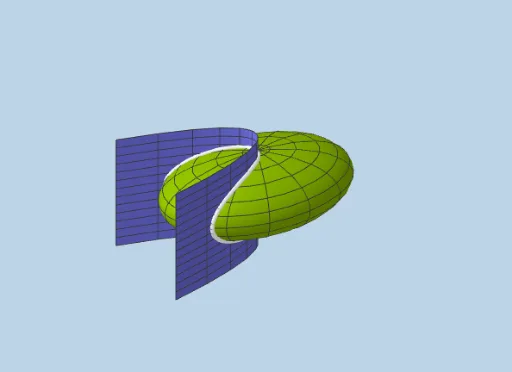
This example demonstrates the intersection of an ellipsoid and a parabolic cylinder. Key mathematical concepts include the intersection of surfaces in solid geometry and the use of Cartesian curves in coordinate geometry. Using GeoGebra commands such as CurveCartesian and Surface, the example allows for dynamic transformations and rotations. Suitable for high school mathematics education, particularly in solid and coordinate geometry.
GeoGebra Commands & Parameters
CurveCartesian(t^(2), t, (c * sqrt(1 - t^(4) / a^(2) - t^(2) / b^(2))), t, (-π), π) → c1CurveCartesian(t^(2), t, ((-c) * sqrt(1 - t^(4) / a^(2) - t^(2) / b^(2))), t, (-π), π) → c2Surface(((a * cos(u)) * cos(v)), ((b * cos(u)) * sin(v)), (c * sin(u)), u, 0, (2 * π), v, 0, π) → fSurface(u^(2), u, v, u, (-1.1 * sqrt(a)), (1.1 * sqrt(a)), v, (-3 / 2 * c), (3 / 2 * c)) → d
AI Drawing Prompt Reference
Draw the intersection of an ellipsoid and a parabolic cylinder. First, draw the ellipsoid with the equation (x/a)^2 + (y/b)^2 + (z/c)^2 = 1. Then, draw two parabolic curves y = x^2 and y = -x^2, which project to curves c1 and c2 on the ellipsoid. Finally, draw the parabolic cylinder with the equation z = x^2, which intersects the ellipsoid to form a 3D shape.
The prompt above was compiled from the original drawing commands and is for reference only.