
Intersection of Chords in a Circle and Similar Triangles
Loading the math board and drawing, please wait…
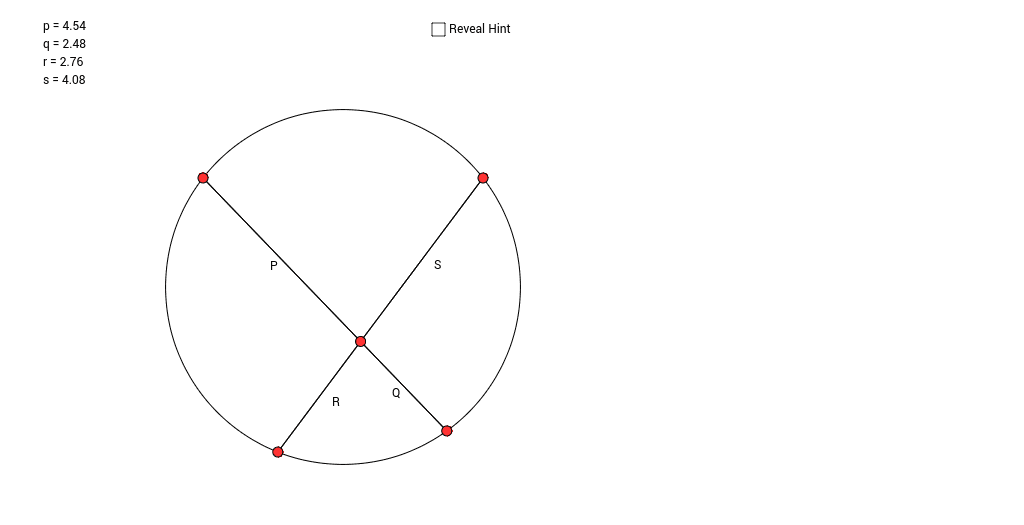
This GeoGebra example demonstrates the intersecting chords theorem within a circle: when two chords intersect at an interior point, the products of the lengths of the resulting four segments are equal. The construction employs Circle to draw the circle, Point to define points on the circumference and the intersection, Segment to construct the chords and their four sub-segments, Intersect to locate the crossing point, and Angle to mark angles that establish similar triangles. Core mathematical concepts include circle geometry, chord intersection, similar triangles, proportional segments, and the algebraic equation relating the four segment lengths. It is suitable for middle school and high school geometry instruction, particularly for exploring the intersecting chords theorem and similarity-based proofs.
GeoGebra Commands & Parameters
Circle(A, B) → cPoint(c) → CPoint(c) → DPoint(c) → ESegment(C, D) → aSegment(E, B) → bIntersect(a, b) → FSegment(C, F) → pSegment(E, F) → rSegment(F, D) → qSegment(F, B) → sSegment(C, E) → dSegment(B, D) → eAngle(E, C, D) → αAngle(E, B, D) → β
AI Drawing Prompt Reference
Draw a circle and mark four points on its circumference. Connect the points to form two intersecting chords that cross inside the circle. Identify the intersection point of the chords and draw the four resulting line segments. Also draw the two triangles formed by the chords and the lines joining their endpoints, and label the angles at the triangle vertices. The construction illustrates the intersecting chords theorem, showing that the product of the lengths of opposite segments are equal, and highlights the similarity of the two triangles through their corresponding angles.
The prompt above was compiled from the original drawing commands and is for reference only.