
Intersection of a Torus and a Plane Defined by Three Points
Loading the math board and drawing, please wait…
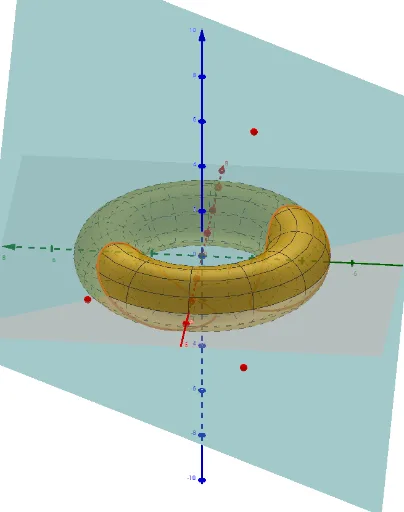
① This example demonstrates the intersection curve between a torus and a plane determined by three points A, B, C in space, with assistance from Wolfram Alpha for computation, visually showing the cross-section geometry of a 3D surface and a plane. ② Core mathematical concepts include solid geometry (plane equations), parametric representation of a torus, solving intersection curves between a surface and a plane, as well as vector orthogonality and mirror transformations. ③ Construction details: GeoGebra commands used include Plane (defining the plane from three points), UnitOrthogonalVector (computing the unit normal vector), Surface (drawing the torus), CurveCartesian (parametric curves), IntersectPath (finding the intersection path), OrthogonalPlane (orthogonal plane), and Mirror (reflection), involving objects such as points A, B, C, radii parameters R and r, and various auxiliary curves and button interactions. ④ Suitable for senior high school or early university students learning solid geometry and spatial analytic geometry, and useful in math lab courses for intuitive exploration of surface cross-sections.
GeoGebra Commands & Parameters
Plane(A, B, C) → aUnitOrthogonalVector(a) → uaSurface(((R + (r * cos(u))) * cos(v)), ((R + (r * cos(u))) * sin(v)), (r * sin(u)), u, 0, (2 * π), v, 0, (2 * π)) → bCurveCartesian(((R + (r * cos(t))) * f(t)), ((R + (r * cos(t))) * g(t)), (r * sin(t)), t, 0, (2 * π)) → cIntersectPath(a, xOyPlane) → iOrthogonalPlane((0, 0, 0), i) → eMirror(c, e) → c'Mirror(C, a) → C'