
Interior Angle Sum of Polygons Demo
Loading the math board and drawing, please wait…
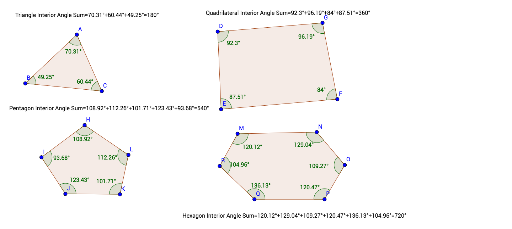
This example demonstrates how to dynamically construct polygons of varying number of sides and calculate their interior angle sums. Key math concepts include polygons, interior angles, angle sum, and mathematical induction. Construction highlights involve commands like Polygon, Angle, and Slider from GeoGebra. Suitable for middle school and above mathematics education, helping students visually understand the patterns and formula derivation of polygon interior angle sums.
GeoGebra Commands & Parameters
Polygon(A, B, C) → poly1, c, a, bAngle(B, A, C) → αAngle(A, C, B) → βAngle(C, B, A) → γPolygon(D, E, F, G) → poly2, d, e, f, gPolygon(H, I, J, K, L) → poly3, h, i, j, k, lPolygon(M, N, O, P, Q, R) → poly4, m, n, o, p, q, rAngle(E, D, G) → εAngle(D, G, F) → ζAngle(G, F, E) → ηAngle(F, E, D) → θAngle(I, H, L) → ιAngle(H, L, K) → κAngle(K, J, I) → λAngle(L, K, J) → μAngle(J, I, H) → νAngle(R, M, N) → ξAngle(M, N, O) → οAngle(N, O, P) → ρAngle(P, Q, R) → σAngle(O, P, Q) → τAngle(Q, R, M) → υ