
Imaginary Number Orbits
Loading the math board and drawing, please wait…
In collections
Complex Math
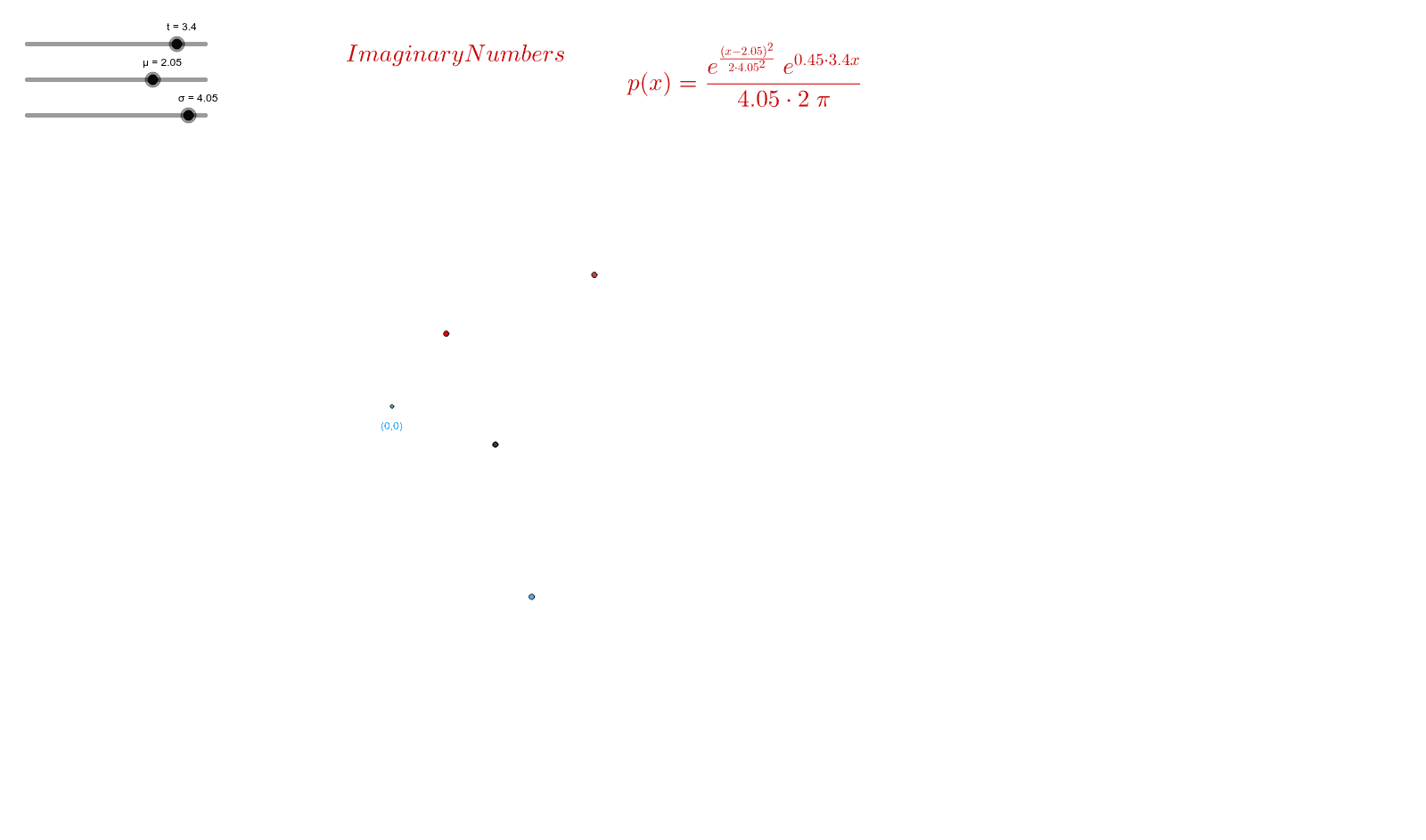
This example demonstrates the motion轨迹 of imaginary numbers in the complex plane. It involves core mathematical concepts such as complex numbers, vectors, transformations, and loci. The construction uses GeoGebra commands like Polygon, Segment, Vector, Translate, and Intersect. It is suitable for high school mathematics students to understand the geometric meaning and dynamic changes of complex numbers.
GeoGebra Commands & Parameters
Polygon(z_1, z_2, z_τ) → poly1, z_3, z_4, z_5Segment(z_6, z_2) → aSegment(z_6, z_τ) → bSegment(z_6, z_1) → cSegment(z_2, z_7) → dSegment(z_7, z_6) → eSegment(z_1, z_7) → iPolygon(z_1, z_6, z_τ) → poly2, z_8, z_9, z_{10}Polygon(z_τ, z_2, z_6) → poly3, z_{11}, z_{12}, z_{13}Polygon(z_6, z_7, z_2) → poly4, z_{14}, z_{15}, z_{16}Polygon(z_7, z_1, z_6) → poly5, z_{17}, z_{18}, z_{19}Vector(A, B) → uTranslate(z_1, u) → z_{9}Translate(z_2, u) → z_{20}Translate(z_τ, u) → z_{21}Polygon(z_{9}, z_{20}, z_{21}) → poly1', z_{22}, z_{23}, z_{24}Vector(C, D) → vTranslate(z_1, v) → z_{25}Translate(z_6, v) → z_{26}Translate(z_τ, v) → z_{27}Polygon(z_{25}, z_{26}, z_{27}) → poly2', z_{28}, z_{29}, z_{30}Vector(E, F) → wTranslate(z_6, w) → z_{31}Translate(z_7, w) → z_{32}Translate(z_2, w) → z_{33}Polygon(z_{31}, z_{32}, z_{33}) → poly4', z_{34}, z_{35}, z_{36}Vector(G, H) → jTranslate(z_7, j) → z_{37}Translate(z_1, j) → z_{38}Translate(z_6, j) → z_{39}Polygon(z_{37}, z_{38}, z_{39}) → poly5', z_{40}, z_{41}, z_{42}Intersect(z_{28}, z_{29}) → IIntersect(z_{41}, z_{42}) → JSegment(I, J) → lIntersect(z_{28}, z_{30}) → KIntersect(z_{40}, z_{41}) → LSegment(K, L) → mIntersect(z_{29}, z_{30}) → MIntersect(z_{40}, z_{42}) → NSegment(M, N) → nIntersect(z_{22}, z_{24}) → OIntersect(z_{34}, z_{36}) → PSegment(O, P) → qIntersect(z_{23}, z_{24}) → QSegment(Q, P) → rIntersect(xAxis, yAxis) → RIntersect(g, p, (-8.254196448459108, 3.275891323225046E-6)) → SIntersect(g, p, (-8.254196448459108, 3.275891323225046E-6)) → TSegment(R, z_τ) → sSegment(z_{46}, z_{44}) → a_1Segment(z_{45}, z_{43}) → b_1