
Identifying Quadrilaterals
Loading the math board and drawing, please wait…
In collections
Quadrilaterals الرُباعيات
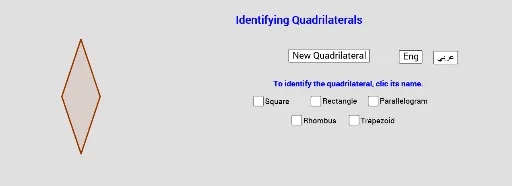
This example demonstrates how to identify different types of quadrilaterals, including rhombus, rectangle, parallelogram, and trapezoid. Key mathematical concepts include angles, area, and properties of quadrilaterals. Using GeoGebra commands like Random and If, the construction process is dynamically shown. Suitable for middle school and above students to learn geometric construction and properties of quadrilaterals.
GeoGebra Commands & Parameters
Random(1, 5) → TypeRandom(10, 80) → αIf(Type ≟ 1, Square[A, B], If[Type ≟ 2, Rectangle[A, B, a], If[Type ≟ 3, Parallelogram[A, B, α°, a], If[Type ≟ 4, Parallelogram[A, B, α°, 1], Trapezoid[A, B, α°, a]]]]) → Quad
AI Drawing Prompt Reference
Draw a random quadrilateral, which could be a square, rectangle, parallelogram, or trapezoid. First, randomly choose the type of quadrilateral, then draw the corresponding shape based on the type. A square has equal sides, a rectangle has equal opposite sides and right angles, a parallelogram has parallel and equal opposite sides, and a trapezoid has one pair of parallel sides.
The prompt above was compiled from the original drawing commands and is for reference only.