
Icosahedron with Pyramids: Geometric Construction
Loading the math board and drawing, please wait…
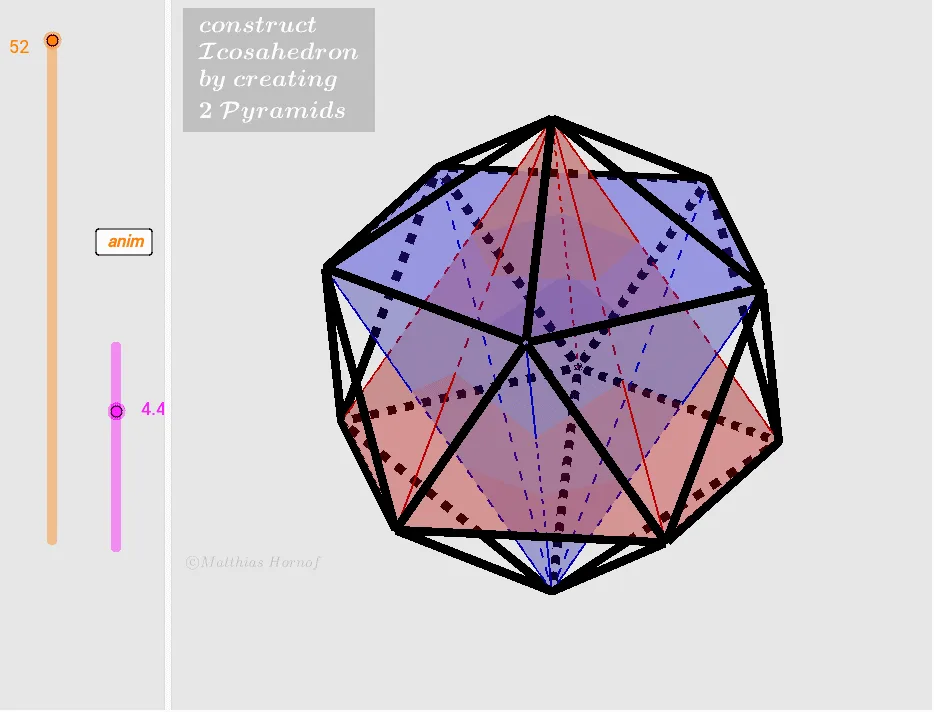
This GeoGebra example demonstrates the geometric construction of a regular icosahedron adorned with pyramids on its faces, showcasing a well-known spatial construction method. The core mathematical concepts involved include solid geometry, coordinate geometry, spatial vectors, and the calculation of angles and segments in three-dimensional space. To build this model, the user employs key GeoGebra commands such as Angle, Pyramid, Segment, and Intersect, working with variables and object names like tau, vertices I_1 to I_{12}, faces Fläche01 to Fläche06, and edges Kante01 to Kante09. It is highly suitable for high school or university students and educators learning advanced spatial geometry, 3D modeling, and interactive geometry software applications.
GeoGebra Commands & Parameters
Angle(Segment[(0, 0, 0), ((-b), 0, a)], zAxis) → w_{2max}Angle(Segment[(0, 0, 0), ((-b), 0, a)], zAxis) → w_{1max}Pyramid(I_1, I_5, I_{10}, I_{11}, I_6, I_4) → c, Fläche01, Kante04, Kante05, Kante06, Kante07, Kante08, Kante09, Kante10, Fläche02, Fläche03, Fläche04, Fläche05, Fläche06, Kante01, Kante02, Kante03Pyramid(I_3, I_7, I_{12}, I_9, I_8, I_2) → d, Fläche07, Kante20, Kante16, Kante22, Kante23, Kante24, Kante25, Kante21, Fläche09, Fläche10, Fläche11, Fläche12, Fläche08, Kante17, Kante18, Kante19Segment(I_7, I_4) → d_{13}Segment(I_4, I_3) → d_{12}Segment(I_4, I_8) → d_{11}Segment(I_4, I_9) → d_{15}Segment(I_4, I_{12}) → d_{14}Segment(I_2, I_5) → d_{17}Segment(I_2, I_{10}) → d_{18}Segment(I_2, I_{11}) → d_{19}Segment(I_2, I_6) → d_{20}Segment(I_2, I_1) → d_{16}Segment(I_5, I_8) → d_3Segment(I_8, I_{10}) → d_4Segment(I_{10}, I_3) → d_5Intersect(Kante03, Kante09) → ASegment(I_3, I_{11}) → d_6Segment(I_{11}, I_7) → d_7Segment(I_7, I_6) → d_8Segment(I_6, I_{12}) → d_9Segment(I_{12}, I_1) → d_{10}Segment(I_1, I_9) → d_1Segment(I_9, I_5) → d_2