
Hyperbolic Octahedron
Loading the math board and drawing, please wait…
In collections
geometriadinamica.es
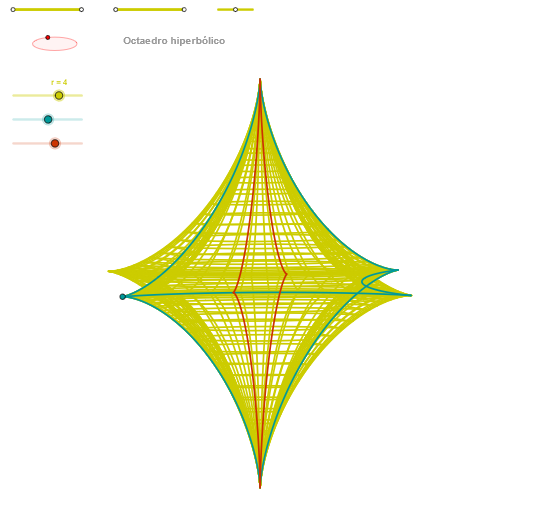
This example demonstrates the construction of a hyperbolic octahedron. It involves key concepts in hyperbolic geometry, such as hyperbolic polygons. Using GeoGebra commands like Segment, Point, OrthogonalLine, etc., the hyperbolic octahedron's faces can be constructed. Suitable for high school or university geometry courses, particularly in solid and hyperbolic geometry.
GeoGebra Commands & Parameters
Segment(Q3, Q4) → p2Point(p2) → P3Segment(P3, Q4) → p4Point(p4) → P4Segment(Q1, Q2) → p1Point(p1) → P1Segment(P1, Q2) → p3Point(p3) → P2OrthogonalLine(C, xAxis) → zz2Circle(C, 0.62) → zz0Intersect(zz0, zz2, 1) → ZZ4Intersect(zz0, zz2, 2) → ZZ3Ellipse(ZZ3, ZZ4, 0.65) → zElipse2Point(zElipse2) → ZIntersect(zElipse2, zz2) → ZZ7, ZZ8Angle(ZZ8, C, Z) → zAngIncOrthogonalLine(C, yAxis) → zz1Intersect(zz0, zz1, 2) → ZZ2Intersect(zz0, zz1, 1) → ZZ1Ellipse(ZZ1, ZZ2, 0.65) → zElipse1Point(zElipse1) → XYIntersect(zElipse1, zz1) → ZZ5, ZZ6Angle(ZZ6, C, XY) → zAngRotSegment(Q5, Q6) → p5Point(p5) → P5Segment(ZZ5, ZZ6) → zz4Segment(ZZ7, ZZ8) → zz3Intersect(zElipse2, zElipse1, 1) → zPunto1Intersect(zElipse2, zElipse1, 4) → zPunto2Segment(zPunto1, zPunto2) → zSeg2CurveCartesian(((1.5 * r) * ((((cos(u) * cos(α)))^(3) * sin(zAngRot)) + (((sin(u) * cos(α)))^(3) * cos(zAngRot)))), ((1.5 * r) * ((((-((cos(u) * cos(α)))^(3)) * cos(zAngRot)) * sin(zAngInc)) + ((((sin(u) * cos(α)))^(3) * sin(zAngRot)) * sin(zAngInc)) + ((sin(α))^(3) * cos(zAngInc)))), u, u1, u2) → curva2CurveCartesian((((1.5 * r) * (cos(v))^(3)) * sin(zAngRot)), ((1.5 * r) * ((((-(cos(v))^(3)) * cos(zAngRot)) * sin(zAngInc)) + ((sin(v))^(3) * cos(zAngInc)))), v, v1, v2) → curva1CurveCartesian(((1.5 * r) * ((((cos(β) * cos(v)))^(3) * sin(zAngRot)) + (((sin(β) * cos(v)))^(3) * cos(zAngRot)))), ((1.5 * r) * ((((-((cos(β) * cos(v)))^(3)) * cos(zAngRot)) * sin(zAngInc)) + ((((sin(β) * cos(v)))^(3) * sin(zAngRot)) * sin(zAngInc)) + ((sin(v))^(3) * cos(zAngInc)))), v, v1, v2) → a1Sequence(CurveCartesian[((1.5 * r) * ((((cos(u) * cos(v)))^(3) * sin(zAngRot)) + (((sin(u) * cos(v)))^(3) * cos(zAngRot)))), ((1.5 * r) * ((((-((cos(u) * cos(v)))^(3)) * cos(zAngRot)) * sin(zAngInc)) + ((((sin(u) * cos(v)))^(3) * sin(zAngRot)) * sin(zAngInc)) + ((sin(v))^(3) * cos(zAngInc)))), v, v1, v2], u, u1, u2, (2 * paso)) → list2Sequence(CurveCartesian[((1.5 * r) * ((((cos(u) * cos(v)))^(3) * sin(zAngRot)) + (((sin(u) * cos(v)))^(3) * cos(zAngRot)))), ((1.5 * r) * ((((-((cos(u) * cos(v)))^(3)) * cos(zAngRot)) * sin(zAngInc)) + ((((sin(u) * cos(v)))^(3) * sin(zAngRot)) * sin(zAngInc)) + ((sin(v))^(3) * cos(zAngInc)))), u, u1, u2], v, v1, v2, paso) → list1
AI Drawing Prompt Reference
Draw a hyperbolic octahedron, showcasing its faces made of hyperbolic polygons. Start by drawing two line segments and creating points on them. Then, use orthogonal lines to construct circles and ellipses from the points. Intersect the ellipses with the lines to find new points, and draw segments and curves connecting them to form the intricate structure of the hyperbolic octahedron, highlighting key concepts in hyperbolic geometry.
The prompt above was compiled from the original drawing commands and is for reference only.