
Hyperbolic Mirror Reflection
Loading the math board and drawing, please wait…
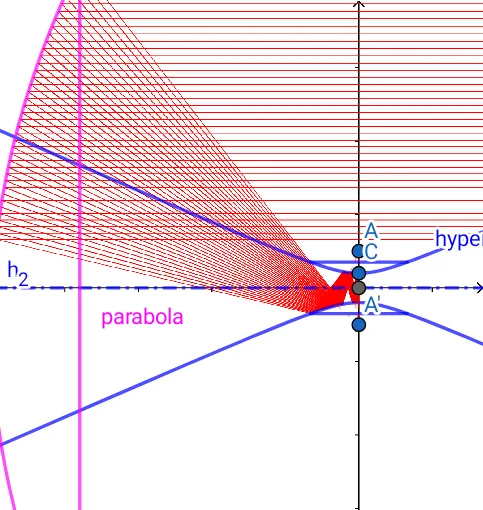
This example demonstrates the reflection of light on a hyperbolic mirror. Key mathematical concepts include hyperbola, reflection, arithmetic mean, and mirror. Using GeoGebra commands such as Point, Mirror, Intersect, Hyperbola, etc., the reflection effect on a hyperbolic mirror is constructed. Suitable for high school mathematics education, particularly in analytic geometry and optics courses.
GeoGebra Commands & Parameters
Point(yAxis) → AMirror(A, xAxis) → A'Intersect(xAxis, yAxis) → BPoint(yAxis) → CHyperbola(A, A', C) → cRotate(yAxis, n, A') → yAxis'Intersect(c, yAxis', 2) → DTangent(D, c) → f,Mirror(yAxis', f) → yAxis''Intersect(c, yAxis'', 2) → ETangent(E, c) → g,Mirror(yAxis'', g) → yAxis'''Intersect(c, yAxis''', 2) → FTangent(F, c) → h,Mirror(yAxis''', h) → iIntersect(c, i, 2) → GTangent(G, c) → j,Mirror(i, j) → i'Intersect(c, i', 2) → HTangent(H, c) → k,Mirror(i', k) → i''Intersect(c, i'', 2) → ITangent(I, c) → l,Mirror(i'', l) → i'''Intersect(c, i''', 2) → JTangent(J, c) → m,Mirror(i''', m) → pIntersect(c, p, 2) → KTangent(K, c) → q,Mirror(p, q) → p'Intersect(c, p', 2) → LSegment(L, K) → rSegment(K, J) → sSegment(J, I) → tSegment(I, H) → aSegment(H, G) → bSegment(G, F) → dSegment(F, E) → eSegment(E, D) → f_1Intersect(c, yAxis', 1) → MIntersect(c, yAxis', 2) → QPoint(xAxis) → NLine(N, yAxis) → g_1Parabola(A', g_1) → c_1LineBisector(C, A) → k_1Intersect(c, k_1, 2) → RLine(A', R) → l_1Intersect(c_1, l_1, 2) → SLine(S, yAxis) → m_1Intersect(c, k_1, 1) → TSegment(R, T) → n_1Intersect(c_1, m_1, 2) → UMirror(R, xAxis) → R'Mirror(T, xAxis) → T'Segment(R', T') → q_1Segment(U, S) → p_1Intersect(c_1, yAxis', 2) → OTangent(O, c_1) → h_1,Mirror(yAxis', h_1) → yAxis''_1Intersect(yAxis''_1, yAxis) → PSegment(O, D) → i_1Ray(O, P) → j_1Intersect(c, i_1, 1) → VSegment(V, A') → r_1Intersect(c, e, 1) → WSegment(W, A) → s_1Intersect(c, d, 1) → ZSegment(Z, A') → t_1Intersect(c, a, 1) → A_1Segment(A_1, A') → a_1Intersect(c, b, 1) → B_1Segment(B_1, A) → b_1Intersect(c, t, 1) → C_1Segment(C_1, A) → d_1Intersect(c, r, 1) → D_1Segment(D_1, A) → e_1Intersect(c, s, 1) → E_1Segment(E_1, A') → f_2Intersect(c, r, 2) → F_1Segment(F_1, A') → g_2Line(B, xAxis) → h_2
AI Drawing Prompt Reference
Draw a hyperbolic mirror. Start by taking a point A on the y-axis, then take point B on the x-axis as the origin. Next, take another point C on the y-axis. Construct a hyperbola c using points A, A' (the mirror image of A across the x-axis), and C. Rotate A' around the y-axis, and find the intersection of the hyperbola c with the rotated y-axis at point D. Draw the tangent line f at point D on the hyperbola c, then mirror f across the rotated y-axis, and continue this process to create a series of tangents and mirrors, finally connecting the series of intersection points to form a closed shape.
The prompt above was compiled from the original drawing commands and is for reference only.