
Hyperbolic Cube
Loading the math board and drawing, please wait…
In collections
geometriadinamica.es
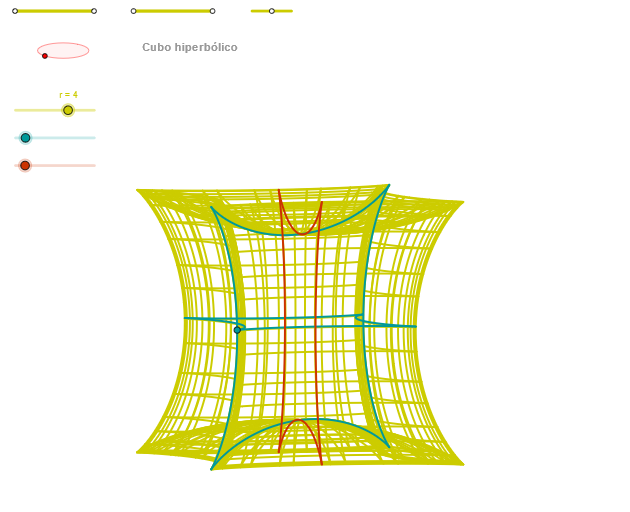
This example demonstrates the geometric construction of a hyperbolic cube. It involves key concepts from hyperbolic and solid geometry. Using GeoGebra commands such as Segment, Point, and OrthogonalLine, the hyperbolic cube's faces and edges can be constructed. Suitable for high school or university solid geometry courses.
GeoGebra Commands & Parameters
Segment(Q3, Q4) → p2Point(p2) → P3Segment(P3, Q4) → p4Point(p4) → P4Segment(Q5, Q6) → p5Point(p5) → P5Segment(Q1, Q2) → p1Point(p1) → P1Segment(P1, Q2) → p3Point(p3) → P2OrthogonalLine(C, xAxis) → zz2Circle(C, 0.62) → zz0Intersect(zz0, zz2, 1) → ZZ4Intersect(zz0, zz2, 2) → ZZ3Ellipse(ZZ3, ZZ4, 0.65) → zElipse2Point(zElipse2) → ZIntersect(zElipse2, zz2) → ZZ7, ZZ8Angle(ZZ8, C, Z) → zAngIncOrthogonalLine(C, yAxis) → zz1Intersect(zz0, zz1, 2) → ZZ2Intersect(zz0, zz1, 1) → ZZ1Ellipse(ZZ1, ZZ2, 0.65) → zElipse1Point(zElipse1) → XYIntersect(zElipse1, zz1) → ZZ5, ZZ6Angle(ZZ6, C, XY) → zAngRotSegment(ZZ5, ZZ6) → zz4Segment(ZZ7, ZZ8) → zz3Intersect(zElipse2, zElipse1, 1) → zPunto1Intersect(zElipse2, zElipse1, 4) → zPunto2Segment(zPunto1, zPunto2) → zSeg2CurveCartesian((r / 1.2 * (((((cos(v))^(3) + (sin(v))^(3)) * ((cos(α))^(3) + (sin(α))^(3))) * sin(zAngRot)) + ((((-(cos(v))^(3)) + (sin(v))^(3)) * ((cos(α))^(3) + (sin(α))^(3))) * cos(zAngRot)))), (r / 1.2 * (((((-((cos(v))^(3) + (sin(v))^(3))) * ((cos(α))^(3) + (sin(α))^(3))) * cos(zAngRot)) * sin(zAngInc)) + (((((-(cos(v))^(3)) + (sin(v))^(3)) * ((cos(α))^(3) + (sin(α))^(3))) * sin(zAngRot)) * sin(zAngInc)) + (((-(cos(α))^(3)) + (sin(α))^(3)) * cos(zAngInc)))), v, v1, v2) → curva2CurveCartesian((r / 1.2 * (((-((cos(u))^(3) + (sin(u))^(3))) * sin(zAngRot)) + (((cos(u))^(3) + (sin(u))^(3)) * cos(zAngRot)))), (r / 1.2 * (((((cos(u))^(3) + (sin(u))^(3)) * cos(zAngRot)) * sin(zAngInc)) + ((((cos(u))^(3) + (sin(u))^(3)) * sin(zAngRot)) * sin(zAngInc)) + (((-(cos(u))^(3)) + (sin(u))^(3)) * cos(zAngInc)))), u, u1, u2) → curva1CurveCartesian((r / 1.2 * (((((cos(β))^(3) + (sin(β))^(3)) * ((cos(u))^(3) + (sin(u))^(3))) * sin(zAngRot)) + ((((-(cos(β))^(3)) + (sin(β))^(3)) * ((cos(u))^(3) + (sin(u))^(3))) * cos(zAngRot)))), (r / 1.2 * (((((-((cos(β))^(3) + (sin(β))^(3))) * ((cos(u))^(3) + (sin(u))^(3))) * cos(zAngRot)) * sin(zAngInc)) + (((((-(cos(β))^(3)) + (sin(β))^(3)) * ((cos(u))^(3) + (sin(u))^(3))) * sin(zAngRot)) * sin(zAngInc)) + (((-(cos(u))^(3)) + (sin(u))^(3)) * cos(zAngInc)))), u, u1, u2) → a1Sequence(CurveCartesian[(r / 1.2 * (((((cos(v))^(3) + (sin(v))^(3)) * ((cos(u))^(3) + (sin(u))^(3))) * sin(zAngRot)) + ((((-(cos(v))^(3)) + (sin(v))^(3)) * ((cos(u))^(3) + (sin(u))^(3))) * cos(zAngRot)))), (r / 1.2 * (((((-((cos(v))^(3) + (sin(v))^(3))) * ((cos(u))^(3) + (sin(u))^(3))) * cos(zAngRot)) * sin(zAngInc)) + (((((-(cos(v))^(3)) + (sin(v))^(3)) * ((cos(u))^(3) + (sin(u))^(3))) * sin(zAngRot)) * sin(zAngInc)) + (((-(cos(u))^(3)) + (sin(u))^(3)) * cos(zAngInc)))), u, u1, u2], v, v1, v2, paso) → list3Sequence(CurveCartesian[(r / 1.2 * (((((cos(v))^(3) + (sin(v))^(3)) * ((cos(u))^(3) + (sin(u))^(3))) * sin(zAngRot)) + ((((-(cos(v))^(3)) + (sin(v))^(3)) * ((cos(u))^(3) + (sin(u))^(3))) * cos(zAngRot)))), (r / 1.2 * (((((-((cos(v))^(3) + (sin(v))^(3))) * ((cos(u))^(3) + (sin(u))^(3))) * cos(zAngRot)) * sin(zAngInc)) + (((((-(cos(v))^(3)) + (sin(v))^(3)) * ((cos(u))^(3) + (sin(u))^(3))) * sin(zAngRot)) * sin(zAngInc)) + (((-(cos(u))^(3)) + (sin(u))^(3)) * cos(zAngInc)))), v, v1, v2], u, u1, u2, paso) → list1
AI Drawing Prompt Reference
Draw a three-dimensional geometric construction of a hyperbolic cube. Start with coordinate axes and a central point. Create two perpendicular ellipses centered at this point, representing two rotation planes. Place points on each ellipse and connect them to form the edges and faces of the cube. Then generate a series of curved grid lines that cover the surface, illustrating the hyperbolic curvature. The final figure includes the central point, two ellipses, several edges, and dense curved meshes, showing a symmetric yet distorted solid shape.
The prompt above was compiled from the original drawing commands and is for reference only.