
How to Square a Rectangle? (Equal-Area Construction)
Loading the math board and drawing, please wait…
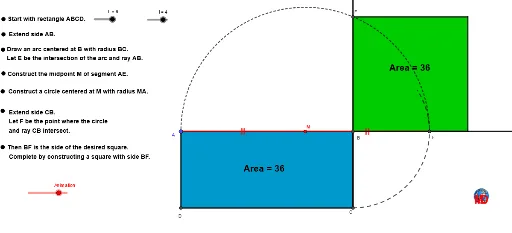
① This example demonstrates a geometric construction that transforms a given rectangle into a square of equal area, a classic problem known as 'squaring the rectangle'. ② Core mathematical concepts include area preservation, similarity transformations, properties of circles and tangents, midpoints and perpendicular lines, and the use of symmetry in geometric construction. ③ Construction highlights: using GeoGebra commands such as Polygon to create the rectangle, Ray and Circle for auxiliary circles, Intersect to find intersection points, Midpoint for midpoints, OrthogonalLine for perpendiculars, Segment to connect key points, Rotate for rotational symmetry, and CircleArc for arcs; objects include rectangle vertices A, B, D, C, auxiliary lines l, q1, q2, and multiple intersection points E, F, G, H, I, J, K, with Animation and text objects to illustrate the dynamic process. ④ Suitable for upper middle school to high school students, useful for understanding area transformations and geometric construction techniques, and ideal for classroom demonstrations or student inquiry-based learning.
GeoGebra Commands & Parameters
Polygon(A, B, C, D) → q1, a, b, d, cRay(A, B) → fCircle(B, C) → eIntersect(e, f) → E_1, EMidpoint(A, E) → MCircle(M, A) → gRay(C, B) → hIntersect(g, h) → F,Circle(B, F) → kIntersect(k, f) → G, HOrthogonalLine(H, f) → iOrthogonalLine(F, h) → jIntersect(i, j) → IPolygon(B, H, I, F) → q2, b_1, h_1, i_1, f_1Midpoint(B, D) → JMidpoint(I, B) → KSegment(A, N) → mRotate(C, If[Animation > 3 + π, π - 1, Animation - 3], B) → C'CircleArc(B, C, C') → pSegment(A, M) → nSegment(M, E) → qRotate(A, If[Animation > 9 + π, (-π), (-(Animation - 9))], M) → A'CircleArc(M, A', A) → rSegment(C, O) → sRotate(I, If[Animation > 22 + π / 2, π / 2, Animation - 22], H) → F'Rotate(B, If[Animation > 18 + π / 2, π / 2, Animation - 18], F) → B'Segment(F, B') → j_1Rotate(F, If[Animation > 20 + π / 2, π / 2, Animation - 20], I) → F'_1Segment(I, F'_1) → k_1Segment(H, F') → g_1