
How to Find the Divisors of an Integer Number
Loading the math board and drawing, please wait…
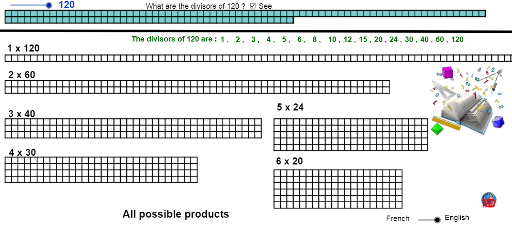
This example demonstrates how to use GeoGebra to find all divisors of an integer number. Key mathematical concepts include integer factorization. Using commands like Sequence, If, and Element, the process of generating divisors is dynamically displayed. Suitable for students from upper elementary to middle school to learn about factorization and divisibility.
GeoGebra Commands & Parameters
Random(1, 60) → nRemoveUndefined(Sequence[If[Mod[f, j] ≟ 0, j], j, 1, f]) → divPolygon((1, 6), (1 + (0.5 * If[f ≤ 75, f, 75]), 6), (1 + (0.5 * If[f ≤ 75, f, 75]), 6.5), (1, 6.5)) → poly1, a, b, c, dIf(IsInteger[Length[div] / 2], Length[div] / 2, Length[div] / 2 + 0.5) → nombreprodElement(div, 4) → prod4Element(div, 1) → prod1Element(div, 2) → prod2Element(div, 3) → prod3Element(div, 5) → prod5Element(div, 6) → prod6Sequence(Segment[(1, 1 - (0.5 * k)), (1 + (0.5 * fact2), 1 - (0.5 * k))], k, 0, prod2) → liste5Sequence(Segment[(1 + (0.5 * k), 1), (1 + (0.5 * k), 1 - (0.5 * prod2))], k, 0, fact2) → liste8Sequence(Segment[(1 + (0.5 * k), -2), (1 + (0.5 * k), -2 - (0.5 * prod3))], k, 0, fact3) → liste9Sequence(Segment[(1, -2 - (0.5 * k)), (1 + (0.5 * fact3), -2 - (0.5 * k))], k, 0, prod3) → liste6Sequence(Segment[(1 + (0.5 * k), -5), (1 + (0.5 * k), -5 - (0.5 * prod4))], k, 0, fact4) → liste10Sequence(Segment[(1, -5 - (0.5 * k)), (1 + (0.5 * fact4), -5 - (0.5 * k))], k, 0, prod4) → liste7Sequence(Segment[(1, 3 - (0.5 * k)), (1 + (0.5 * fact1), 3 - (0.5 * k))], k, 0, prod1) → liste2Sequence(Segment[(1 + (0.5 * k), 3), (1 + (0.5 * k), 3 - (0.5 * prod1))], k, 0, fact1) → liste3Line(A, B) → eSequence(E + ((1.2 * i), 0), i, 1, Length[div]) → liste14Sequence(Text[Element[div, k] + " , ", Element[liste14, k]], k, 1, Length[div] - 1) → liste15Polygon((1, 5.5), (1 + (0.5 * If[f > 75, f - 75, 75]), 5.5), (1 + (0.5 * If[f > 75, f - 75, 75]), 6), (1, 6)) → poly2, g, h, i, jSequence(Segment[(22 + (0.5 * k), -2), (22 + (0.5 * k), -2 - (0.5 * prod5))], k, 0, fact5) → liste11Sequence(Segment[(22, -2 - (0.5 * k)), (22 + (0.5 * fact5), -2 - (0.5 * k))], k, 0, prod5) → liste4Sequence(Segment[(22, -6 - (0.5 * k)), (22 + (0.5 * fact6), -6 - (0.5 * k))], k, 0, prod6) → liste13Sequence(Segment[(22 + (0.5 * k), -6), (22 + (0.5 * k), -6 - (0.5 * prod6))], k, 0, fact6) → liste12Sequence(Segment[(1 + (k * 0.5), 5.5), (1 + (k * 0.5), 6)], k, 1, f - 75) → liste16Sequence(Segment[(1 + (k * 0.5), 6), (1 + (k * 0.5), 6.5)], k, 1, If[f ≤ 75, f - 1, 75]) → liste1