
How Many Pyramids in a Cube?
Loading the math board and drawing, please wait…
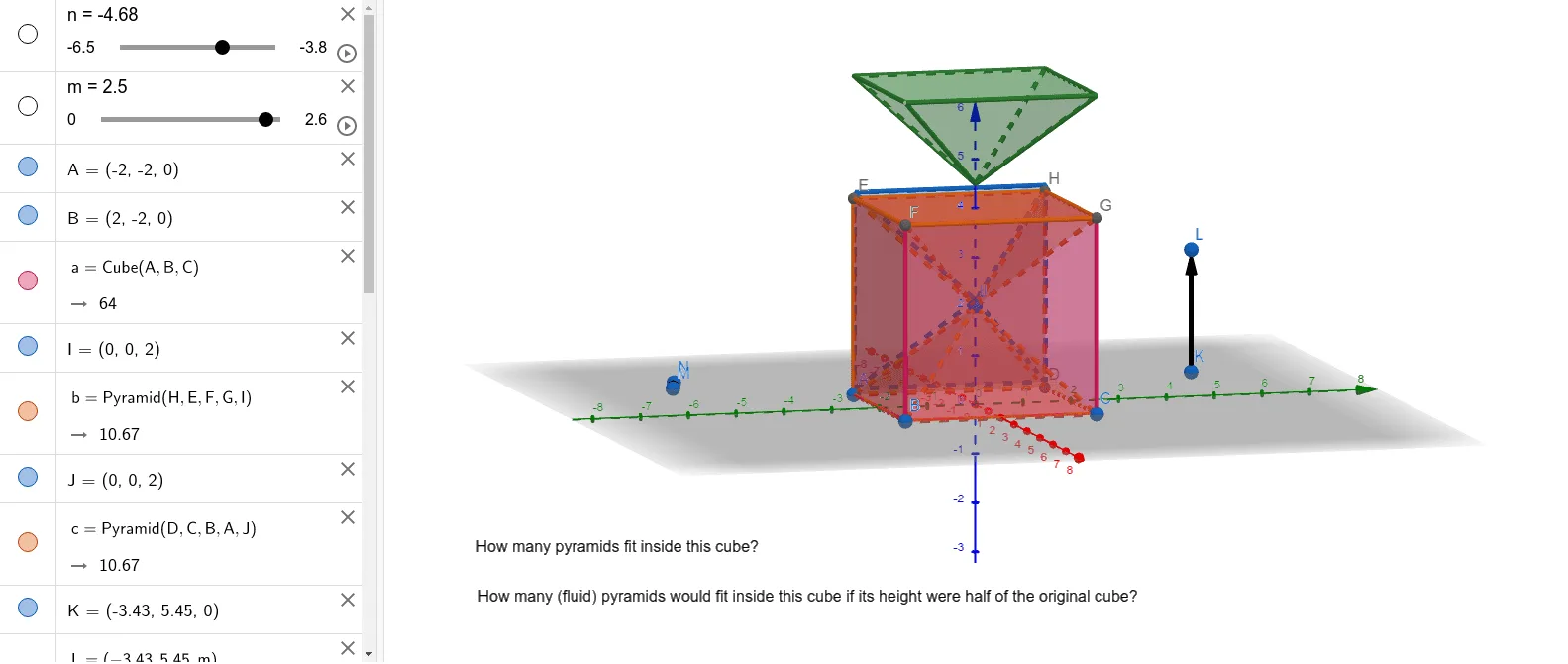
① This 3D dynamic geometry example visually demonstrates how many congruent square pyramids (pyramids) can be constructed inside a cube, and explores the spatial partitioning of the cube. ② Core mathematical concepts include solid geometry, volume of pyramids, containment relationships between a cube and pyramids, spatial translation and symmetry, and the use of geometric distribution in counting configurations. ③ Construction details: Using GeoGebra commands Point, Cube, Pyramid, Vector, and Translate, the example first builds a cube ABCD-EFGH, then generates an interior point I via vector translation, and constructs a square pyramid with base EFGH and apex I using the Pyramid command. Multiple faces (faceEFGH, faceEHI, etc.) and edges (edgeEH, edgeEF, etc.) are created to clearly visualize the structure. ④ Suitable for upper secondary or early university students in solid geometry lessons, and useful for inquiry-based learning to understand pyramid volume formulas and spatial construction methods.
GeoGebra Commands & Parameters
Point(Circle[B, Distance[A, B], Segment[A, B]]) → CCube(A, B, C) → a, D, faceCDHG, faceEFGH_1, edgeAD_1, edgeAB_1, edgeBC_1, edgeCD_1, edgeAE_1, edgeDH_1, edgeEH_1, edgeEF_1, E, edgeBF, edgeFG_1, edgeCG, edgeGH_1, F, G, H, faceABCD_1, faceADHE_1, faceABFE, faceBCGFPyramid(H, E, F, G, I) → b, faceEFGH, edgeHI, edgeEI, edgeFI, edgeGI, faceEHI, faceEFI, faceFGI, faceGHI, edgeEH_2, edgeEF, edgeFG, edgeGHPyramid(D, C, B, A, J) → c, faceABCD, edgeDJ_1, edgeCJ, edgeBJ, edgeAJ_1, faceCDJ, faceBCJ, faceABJ, faceADJ_1, edgeCD, edgeBC, edgeAB, edgeAD_2Vector(K, L) → uTranslate(b, u) → c'Pyramid(D, A, E, H, J) → d, faceADHE, edgeDJ, edgeAJ, edgeEJ, edgeHJ, faceADJ, faceAEJ, faceEHJ, faceDHJ, edgeAD, edgeAE, edgeEH, edgeDHVector(M, N) → vTranslate(d, v) → d'
AI Drawing Prompt Reference
Draw a cube ABCD-EFGH, then create a point I at its center, use I as the apex and EFGH as the base to construct a square pyramid. Next, construct another square pyramid with base ABCD and apex J. Finally, translate the first pyramid along vector u and the second pyramid along vector v to observe the distribution of the square pyramids within the cube.
The prompt above was compiled from the original drawing commands and is for reference only.