
HKDSE 2013 Paper I #18 Geometric Construction
Loading the math board and drawing, please wait…
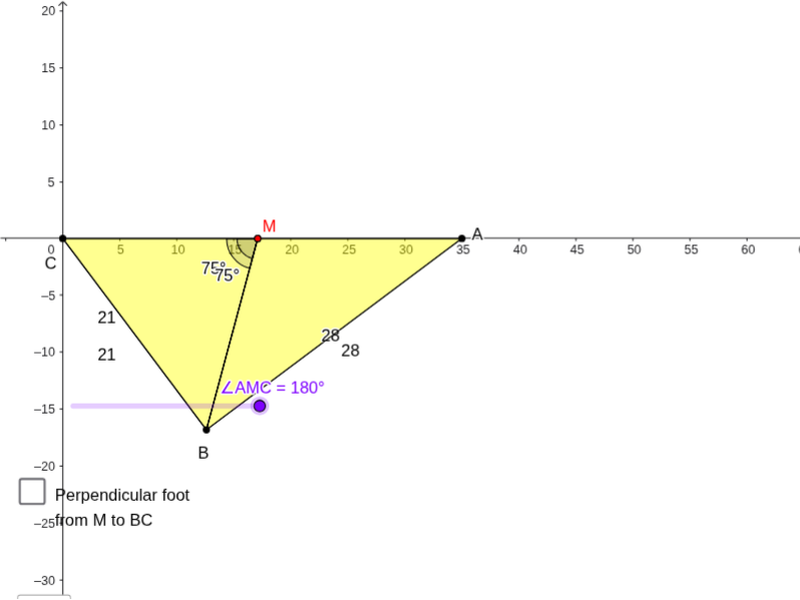
This example demonstrates the geometric construction of an isosceles triangle, rotation, and angle measurement using GeoGebra. Core concepts include properties of isosceles triangles, rotational transformations, angle measurement, and polygon construction. Key GeoGebra commands and objects used are Circle, Intersect, Rotate, Line, Angle, Polygon, Distance, Segment, Sphere, IntersectConic, and If. Suitable for high school mathematics geometry construction teaching and skill enhancement.
GeoGebra Commands & Parameters
Circle(C, 21) → cCircle(A, 28) → dIntersect(c, d, 2) → BRotate(A, 75°, C) → A'_1Line(A'_1, C) → aLine(B, a) → bIntersect(b, xAxis) → MAngle(C, M, B) → αPolygon(C, B, M) → poly1, m, c_1, b_1Polygon(M, B, A) → poly2, a_1, m_1, b_2Distance(C, M) → CMDistance(M, A) → MADistance(M, C) → MCCircle(B, 28) → eCircle(C, AC) → fIntersect(e, f, 2) → A'Segment(A', B) → gSegment(C, A') → hDistance(B, M) → BMSphere(C, CM) → iSphere(A', MA) → jIntersectConic(i, j) → kSphere(B, BM) → lIntersectConic(l, i) → pIf(Defined[Intersect[p, k, 2]], Intersect[p, k, 2], M) → M'Polygon(C, M', B) → poly3, b_3, c_2, m'Polygon(M', A', B) → poly4, n, q, rAngle(B, M', C) → βAngle(C, M', A') → γIntersect(OrthogonalLine[M, Line[B, C]], Line[B, C]) → NSegment(N, M') → sSegment(N, A') → tAngle(M', N, C) → δAngle(B, N, A', space) → ε
AI Drawing Prompt Reference
Start by drawing two intersecting circles with fixed centers, and take the upper intersection as a vertex to form an isosceles triangle. Rotate one vertex around the midpoint of the base by 75 degrees to get a new point, then connect it to the base endpoints to form the rotated triangle. Measure the corresponding angles before and after rotation. Then draw circles centered at the original triangle's vertices to construct a congruent triangle, and use intersections of spheres and cones to determine symmetric points, finally forming two congruent isosceles triangles and measuring related angles and distances.
The prompt above was compiled from the original drawing commands and is for reference only.