
Hexagonal Kaleidoscope Pattern
Loading the math board and drawing, please wait…
In collections
Symmetry, Transformation and Tessellation
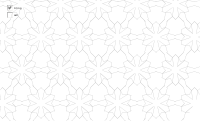
This example demonstrates the creation of a kaleidoscope pattern from hexagons through reflection and rotation; core math concepts include symmetry, rotation, and polygon construction; construction highlights involve commands like Segment, Midpoint, Mirror, Rotate, Vector, Sequence, and Line to build basic shapes and iterate for complexity; suitable for high school mathematics teaching to understand transformation geometry and symmetry principles.
GeoGebra Commands & Parameters
Segment(M, Q) → fSegment(M, P) → eSegment(M, N) → dSegment(L, M) → cSegment(C, B) → hMidpoint(A, B) → HSegment(E, H) → bMirror(cell1, b) → cell2Rotate(cell12, 240*°, E) → cell56Rotate(cell12, 120*°, E) → cell34Mirror(cell123456, h) → cell789012Midpoint(C, A) → GMidpoint(B, D) → IMidpoint(D, C) → JMidpoint(C, B) → KVector(A, B) → uVector(A, C) → vSegment(E, G) → aSequence(Translate[Sequence[Translate[tile, Vector[(n * u)]], n, -3, 3], Vector[(m * v)]], m, -3, 3) → tilingVector(B, D) → wVector(C, D) → gSegment(F, J) → jSegment(F, I) → kSegment(E, F) → iSegment(A, E) → pSegment(E, C) → qSegment(E, B) → rSegment(F, C) → sSegment(F, B) → tSegment(F, D) → a_1Line(A, E) → b_1Line(C, E) → c_1Line(B, E) → d_1Line(B, F) → e_1Line(C, F) → f_1Line(C, B) → g_1Line(A, B) → h_1Line(C, D) → i_1Line(B, D) → j_1Line(A, C) → k_1Line(G, q) → l_1Line(K, q) → m_1Line(I, t) → n_1Line(H, r) → p_1Line(K, r) → q_1Line(J, k) → r_1Line(H, i) → s_1Line(G, i) → t_1Line(G, H) → a_2Line(H, K) → b_2Line(K, G) → c_2Line(I, J) → d_2
AI Drawing Prompt Reference
Create a kaleidoscope pattern using hexagons to demonstrate symmetry through reflection and rotation. Start by drawing a central point and then create three segments radiating from it to form the basic hexagon structure. Next, rotate the hexagon 120° and 240° around the center point, and reflect each rotated shape to generate symmetrical patterns. Finally, combine all the basic shapes to form a complex and intricate kaleidoscope design.
The prompt above was compiled from the original drawing commands and is for reference only.