
Graphical Multiplication Table by Bill Lombard
Loading the math board and drawing, please wait…
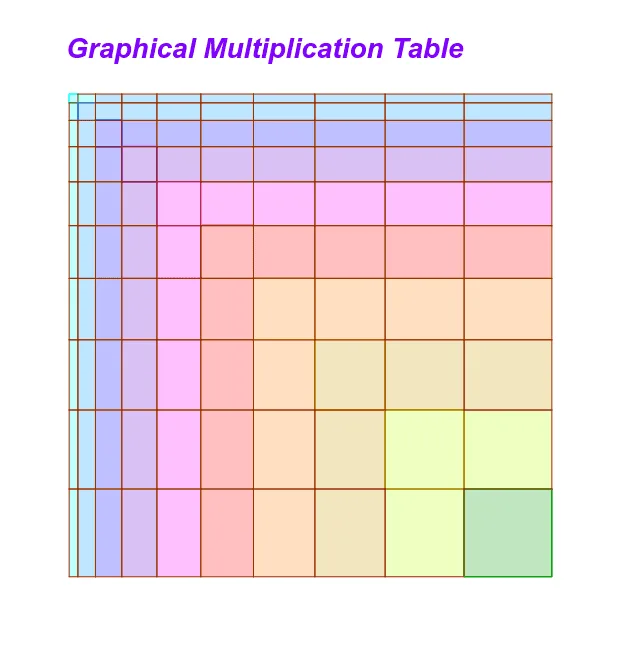
Illustrate a multiplication table using a graphical method to help students understand the relative sizes of various products. This example uses Point, Intersect, and Polygon commands in GeoGebra. Suitable for students from upper elementary to middle school learning multiplication.
GeoGebra Commands & Parameters
Point(xAxis) → AIntersect(xAxis, yAxis) → BPolygon(A, B, 4) → poly1, a, b, c, d, C, DPoint(xAxis) → FPolygon(A, D, E, F) → poly2, a_1, d_1, e, fPoint(xAxis) → GPolygon(F, G, H, E) → poly3, f_1, g, h, e_1Point(xAxis) → IPolygon(G, I, J, H) → poly4, g_1, i, j, h_1Point(xAxis) → KPolygon(I, K, L, J) → poly5, i_1, k, l, j_1Point(xAxis) → MPolygon(K, M, N, L) → poly6, k_1, m, n, l_1Point(xAxis) → OPolygon(M, O, P, N) → poly7, m_1, o, p, n_1Point(xAxis) → QPolygon(O, Q, R, P) → poly8, o_1, q, r, p_1Point(xAxis) → SPolygon(Q, S, T, R) → poly9, q_1, s, t, r_1Point(xAxis) → UPolygon(S, U, V, T) → poly10, s_1, u, v, t_1Point(yAxis) → WPolygon(C, W, Z, D) → poly11, c_1, w, z, d_2Point(yAxis) → A_1Polygon(W, A_1, B_1, Z) → poly12, w_1, a_2, b_1, z_1Point(yAxis) → C_1Polygon(A_1, C_1, D_1, B_1) → poly13, a_3, c_2, d_3, b_2Point(yAxis) → E_1Polygon(C_1, E_1, F_1, D_1) → poly14, c_3, e_2, f_2, d_4Point(yAxis) → G_1Polygon(E_1, G_1, H_1, F_1) → poly15, e_3, g_2, h_2, f_3Point(yAxis) → I_1Polygon(G_1, I_1, J_1, H_1) → poly16, g_3, i_2, j_2, h_3Point(yAxis) → K_1Polygon(I_1, K_1, L_1, J_1) → poly17, i_3, k_2, l_2, j_3Point(yAxis) → M_1Polygon(K_1, M_1, N_1, L_1) → poly18, k_3, m_2, n_2, l_3Point(yAxis) → O_1Polygon(M_1, O_1, P_1, N_1) → poly19, m_3, o_2, p_2, n_3Polygon(D, Z, 4) → poly20, q_2, r_2, s_2, t_2, Q_1, R_1Polygon(Q_1, S_1, 4) → poly21, b_3, p_3, q_3, r_3, T_1, U_1Polygon(T_1, V_1, 4) → poly22, s_3, t_3, a_4, b_4, W_1, Z_1Polygon(W_1, A_2, 4) → poly23, c_4, e_4, f_4, g_4, B_2, C_2Polygon(B_2, D_2, 4) → poly24, h_4, i_4, j_4, k_4, E_2, F_2Polygon(E_2, G_2, 4) → poly25, l_4, m_4, n_4, p_4, H_2, I_2Polygon(H_2, J_2, 4) → poly26, q_4, r_4, s_4, t_4, K_2, L_2Polygon(K_2, M_2, 4) → poly27, a_5, b_5, c_5, d_5, N_2, O_2Polygon(N_2, P_2, 4) → poly28, e_5, f_5, g_5, h_5, Q_2, R_2Polygon(E, Q_1, U_1, H) → poly29, e_6, q_5, u_1, h_6Polygon(U_1, S_2, J, H) → poly30, u_2, s_5, j_5, h_7Polygon(S_2, U_1, T_1, Z_1) → poly31, s_6, u_3, t_5, z_2Polygon(B_1, S_1, Q_1, Z) → poly32, b_6, s_7, q_6, z_3Polygon(D_1, T_2, S_1, B_1) → poly33, d_6, t_6, s_8, b_7Polygon(S_1, T_1, V_1, T_2) → poly34, s_9, t_7, v_1, t_8Polygon(D_1, F_1, U_2, T_2) → poly35, d_7, f_6, u_4, t_9Polygon(T_2, U_2, V_2, V_1) → poly36, t_{10}, u_5, v_2, v_3Polygon(V_1, V_2, A_2, W_1) → poly37, v_4, v_5, a_6, w_2Polygon(F_1, H_1, W_2, U_2) → poly38, f_7, h_8, w_3, u_6Polygon(U_2, W_2, Z_2, V_2) → poly39, u_7, w_4, z_4, v_6Polygon(H_1, J_1, A_3, W_2) → poly40, h_9, j_6, a_7, w_5Polygon(W_2, A_3, B_3, Z_2) → poly41, w_6, a_8, b_8, z_5Polygon(V_2, Z_2, C_3, A_2) → poly42, v_7, z_6, c_6, a_9Polygon(A_2, C_3, D_2, B_2) → poly43, a_{10}, c_7, d_8, b_9Polygon(Z_2, B_3, D_3, C_3) → poly44, z_7, b_{10}, d_9, c_8Polygon(C_3, D_3, E_3, D_2) → poly45, c_9, d_{10}, e_7, d_{11}Polygon(D_2, E_3, G_2, E_2) → poly46, d_{12}, e_8, g_6, e_9Polygon(J_1, L_1, F_3, A_3) → poly47, j_7, l_5, f_8, a_{11}Polygon(A_3, F_3, G_3, B_3) → poly48, a_{12}, f_9, g_7, b_{11}Polygon(B_3, G_3, H_3, D_3) → poly49, b_{12}, g_8, h_{10}, d_{13}Polygon(D_3, H_3, I_3, E_3) → poly50, d_{14}, h_{11}, i_5, e_{10}Polygon(E_3, I_3, J_3, G_2) → poly51, e_{11}, i_6, j_8, g_9Polygon(G_2, J_3, J_2, H_2) → poly52, g_{10}, j_9, j_{10}, h_{12}Polygon(L_1, N_1, K_3, F_3) → poly53, l_6, n_5, k_5, f_{10}Polygon(F_3, K_3, L_3, G_3) → poly54, f_{11}, k_6, l_7, g_{11}Polygon(G_3, L_3, M_3, H_3) → poly55, g_{12}, l_8, m_5, h_{13}Polygon(H_3, M_3, N_3, I_3) → poly56, h_{14}, m_6, n_6, i_7Polygon(I_3, N_3, O_3, J_3) → poly57, i_8, n_7, o_3, j_{11}Polygon(J_3, O_3, P_3, J_2) → poly58, j_{12}, o_4, p_5, j_{13}Polygon(J_2, P_3, M_2, K_2) → poly59, j_{14}, p_6, m_7, k_7Polygon(N_1, P_1, Q_3, K_3) → poly60, n_8, p_7, q_7, k_8Polygon(K_3, Q_3, R_3, L_3) → poly61, k_9, q_8, r_5, l_9Polygon(L_3, R_3, S_3, M_3) → poly62, l_{10}, r_6, s_{10}, m_8Polygon(M_3, S_3, T_3, N_3) → poly63, m_9, s_{11}, t_{11}, n_9Polygon(N_3, T_3, U_3, O_3) → poly64, n_{10}, t_{12}, u_8, o_5Polygon(O_3, U_3, V_3, P_3) → poly65, o_6, u_9, v_8, p_8Polygon(P_3, V_3, W_3, M_2) → poly66, p_9, v_9, w_7, m_{10}Polygon(M_2, W_3, P_2, N_2) → poly67, m_{11}, w_8, p_{10}, n_{11}Polygon(J, S_2, Z_3, L) → poly68, j_{15}, s_{12}, z_8, l_{11}Polygon(S_2, Z_1, A_4, Z_3) → poly69, s_{13}, z_9, a_{13}, z_{10}Polygon(Z_1, W_1, C_2, A_4) → poly70, z_{11}, w_9, c_{10}, a_{14}Polygon(L, Z_3, B_4, N) → poly71, l_{12}, z_{12}, b_{13}, n_{12}Polygon(Z_3, A_4, C_4, B_4) → poly72, z_{13}, a_{15}, c_{11}, b_{14}Polygon(A_4, C_2, D_4, C_4) → poly73, a_{16}, c_{12}, d_{15}, c_{13}Polygon(C_2, B_2, F_2, D_4) → poly74, c_{14}, b_{15}, f_{12}, d_{16}Polygon(N, B_4, E_4, P) → poly75, n_{13}, b_{16}, e_{12}, p_{11}Polygon(B_4, C_4, F_4, E_4) → poly76, b_{17}, c_{15}, f_{13}, e_{13}Polygon(C_4, D_4, G_4, F_4) → poly77, c_{16}, d_{17}, g_{13}, f_{14}Polygon(D_4, F_2, H_4, G_4) → poly78, d_{18}, f_{15}, h_{15}, g_{14}Polygon(F_2, E_2, I_2, H_4) → poly79, f_{16}, e_{14}, i_9, h_{16}Polygon(P, E_4, I_4, R) → poly80, p_{12}, e_{15}, i_{10}, r_7Polygon(E_4, F_4, J_4, I_4) → poly81, e_{16}, f_{17}, j_{16}, i_{11}Polygon(F_4, G_4, K_4, J_4) → poly82, f_{18}, g_{15}, k_{10}, j_{17}Polygon(G_4, H_4, L_4, K_4) → poly83, g_{16}, h_{17}, l_{13}, k_{11}Polygon(H_4, I_2, M_4, L_4) → poly84, h_{18}, i_{12}, m_{12}, l_{14}Polygon(I_2, H_2, L_2, M_4) → poly85, i_{13}, h_{19}, l_{15}, m_{13}Polygon(R, I_4, N_4, T) → poly86, r_8, i_{14}, n_{14}, t_{13}Polygon(I_4, J_4, O_4, N_4) → poly87, i_{15}, j_{18}, o_7, n_{15}Polygon(J_4, K_4, P_4, O_4) → poly88, j_{19}, k_{12}, p_{13}, o_8Polygon(K_4, L_4, Q_4, P_4) → poly89, k_{13}, l_{16}, q_9, p_{14}Polygon(L_4, M_4, R_4, Q_4) → poly90, l_{17}, m_{14}, r_9, q_{10}Polygon(M_4, L_2, S_4, R_4) → poly91, m_{15}, l_{18}, s_{14}, r_{10}Polygon(L_2, K_2, O_2, S_4) → poly92, l_{19}, k_{14}, o_9, s_{15}Polygon(T, N_4, T_4, V) → poly93, t_{14}, n_{16}, t_{15}, v_{10}Polygon(N_4, O_4, U_4, T_4) → poly94, n_{17}, o_{10}, u_{10}, t_{16}Polygon(O_4, P_4, V_4, U_4) → poly95, o_{11}, p_{15}, v_{11}, u_{11}Polygon(P_4, Q_4, W_4, V_4) → poly96, p_{16}, q_{11}, w_{10}, v_{12}Polygon(Q_4, R_4, Z_4, W_4) → poly97, q_{12}, r_{11}, z_{14}, w_{11}Polygon(R_4, S_4, A_5, Z_4) → poly98, r_{12}, s_{16}, a_{17}, z_{15}Polygon(S_4, O_2, B_5, A_5) → poly99, s_{17}, o_{12}, b_{18}, a_{18}Polygon(O_2, N_2, R_2, B_5) → poly100, o_{13}, n_{18}, r_{13}, b_{19}
AI Drawing Prompt Reference
Draw a multiplication table with a 10x10 grid of squares, where each square represents a multiplication result. Start from the bottom left corner and draw each square sequentially to form a grid of smaller squares. The grid is made up of horizontal and vertical lines, with each square having a side length of 1 unit.
The prompt above was compiled from the original drawing commands and is for reference only.