
Graph Isomorphism Problem 1
Loading the math board and drawing, please wait…
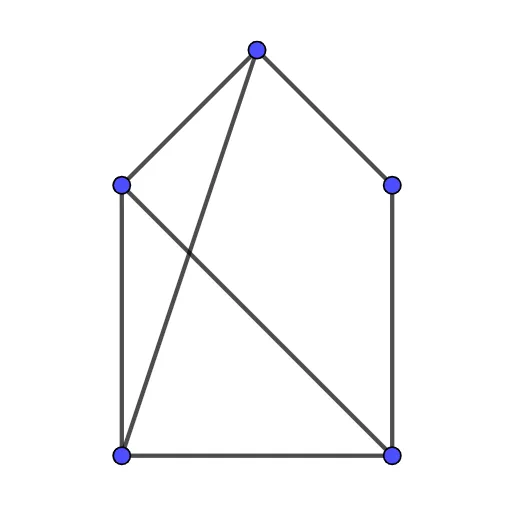
① This GeoGebra example demonstrates the first problem of graph isomorphism, illustrating whether two graphs are structurally equivalent by matching vertices and edges. ② The core mathematical concept is the isomorphism mapping in graph theory, which requires a bijection preserving adjacency relations, involving combinatorial and symmetry analysis. ③ Construction details: Based on the construction summary, the Segment command is used to create line segments, with points A, B, C, D, E and segments f, g, h, i, j, k, l defined as objects; these segments form the edges of the graphs, and by adjusting vertex positions or labels, the connection patterns of two graphs can be compared. ④ Suitable for high school or university discrete mathematics courses on graph theory basics, also useful for math competitions or visual teaching to help students intuitively understand isomorphism determination.
GeoGebra Commands & Parameters
Segment(A, B) → fSegment(C, B) → gSegment(E, A) → hSegment(E, D) → iSegment(D, C) → jSegment(D, A) → kSegment(E, B) → l
AI Drawing Prompt Reference
Draw two similar undirected graphs side by side to illustrate graph isomorphism. Each graph should have 5 vertices connected by 7 edges. The first graph has edges connecting vertex pairs in the pattern: one vertex connected to two others, another vertex connected to three others, and so on, forming a specific connection structure. The second graph should have exactly the same adjacency relationships but with vertices repositioned. The two graphs are displayed together to show how a bijective mapping between vertices preserves the edge connections, demonstrating the concept of graph isomorphism in discrete mathematics.
The prompt above was compiled from the original drawing commands and is for reference only.