
Graph Isomorphism Demo
Loading the math board and drawing, please wait…
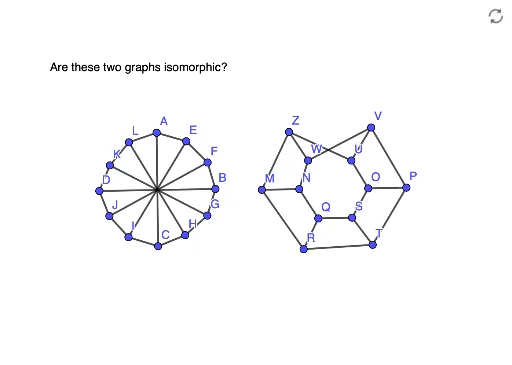
This example demonstrates the concept of graph isomorphism by visually showing whether two graphs are isomorphic. It involves core mathematical concepts like graph theory and combinatorics. Construction highlights include using the Segment command to create vertices and edges with objects such as A, B, C, D, f, g, E, F, G, H, I, J, K, L, h, i, j, k, l, m, n, p, q, r, s, t, a, b, c, d, M, N, O, P, Q, R, S, T, U, V. Suitable for high school students and above to learn graph theory basics and for math competition preparation.
GeoGebra Commands & Parameters
Segment(A, C) → fSegment(D, B) → gSegment(L, H) → hSegment(K, G) → iSegment(E, I) → jSegment(J, F) → kSegment(A, E) → lSegment(E, F) → mSegment(F, B) → nSegment(B, G) → pSegment(G, H) → qSegment(H, C) → rSegment(C, I) → sSegment(I, J) → tSegment(J, D) → aSegment(D, K) → bSegment(K, L) → cSegment(L, A) → dSegment(W, Z) → eSegment(N, M) → f_1Segment(Q, R) → g_1Segment(S, T) → h_1Segment(O, P) → i_1Segment(U, V) → j_1Segment(W, N) → l_1Segment(N, Q) → m_1Segment(Q, S) → n_1Segment(S, O) → p_1Segment(O, U) → q_1Segment(Z, M) → k_1Segment(M, R) → r_1Segment(R, T) → s_1Segment(T, P) → t_1Segment(P, V) → a_1Segment(V, W) → b_1Segment(Z, U) → c_1