
Gradient Function of Natural Log Demonstration
Loading the math board and drawing, please wait…
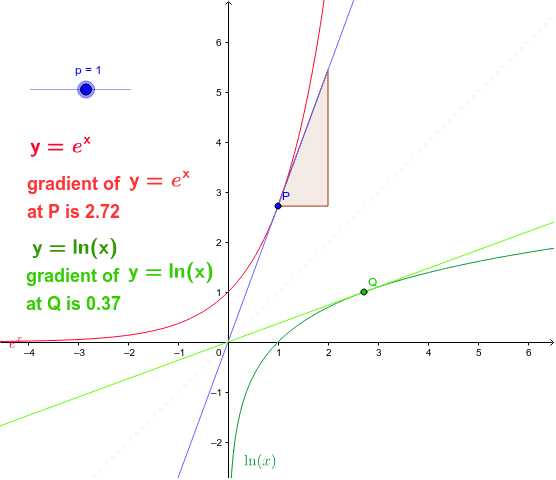
This example demonstrates the relationship between the graphs of exponential function y=e^x and logarithmic function y=ln(x), focusing on their properties as inverse functions. Key math concepts include inverse functions, derivatives, and the characteristics of exponential and logarithmic functions. GeoGebra commands used in construction: Mirror, Tangent, Slope; objects: p, f, P, g, h, Q, t1, t2, s1, s2, text3, text2, text1, text4. Suitable for high school or introductory university students to understand the symmetry of inverse function graphs and the geometric meaning of derivatives.
GeoGebra Commands & Parameters
Mirror(P, h) → QTangent(p, f) → t1Tangent(Q, g) → t2Slope(t1) → s1Slope(t2) → s2
AI Drawing Prompt Reference
Draw a graph demonstrating the relationship between the exponential function y=e^x and the logarithmic function y=ln(x), highlighting their symmetry as inverse functions. Include the tangent lines for both functions and calculate their slopes to show the derivative relationship. Start by plotting the two functions, then find the tangent line for the exponential function, followed by the tangent line for the inverse function, and finally calculate and display the slopes of both tangents to illustrate the equality of derivatives.
The prompt above was compiled from the original drawing commands and is for reference only.