
Gradient and Level Surfaces: 3D Vector Field Visualization
Loading the math board and drawing, please wait…
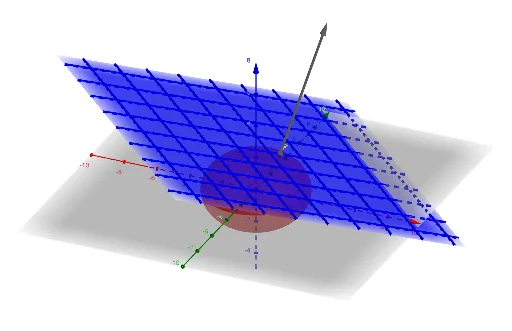
This GeoGebra example demonstrates the geometric relationship between gradient vectors and level surfaces in three-dimensional space. The core mathematical concept is the gradient of a multivariate function—the gradient points in the direction of steepest increase and is perpendicular to the level surface at any given point. Construction highlights: using the Vector command to create vector objects, combined with points P, parameters a and b, and curve c, the gradient vectors are drawn on the level surface to visually confirm orthogonality. This resource is ideal for university-level calculus or multivariable function courses, helping students grasp the connection between gradients, directional derivatives, and level surfaces. It also suits advanced high school mathematics or teacher demonstrations. By dragging parameters or points, learners can dynamically observe how gradient directions change with position, deepening intuition about vector fields and surface geometry.
GeoGebra Commands & Parameters
Vector(P, (3, 3, sqrt((c - 2) / 2) + (4 * sqrt((c - 2) / 2)))) → u
AI Drawing Prompt Reference
Create a 3D mathematical visualization showing a curved surface representing level surfaces with a gradient vector emanating from a point on the surface. The vector should point in the direction of steepest ascent and appear perpendicular to the surface at that point, illustrating the fundamental relationship between gradients and level surfaces in multivariable calculus. Dynamic adjustment of the point position demonstrates how gradient direction changes with location while maintaining orthogonality to the surface.
The prompt above was compiled from the original drawing commands and is for reference only.