
Tangent Plane to a Surface of Revolution
Loading the math board and drawing, please wait…
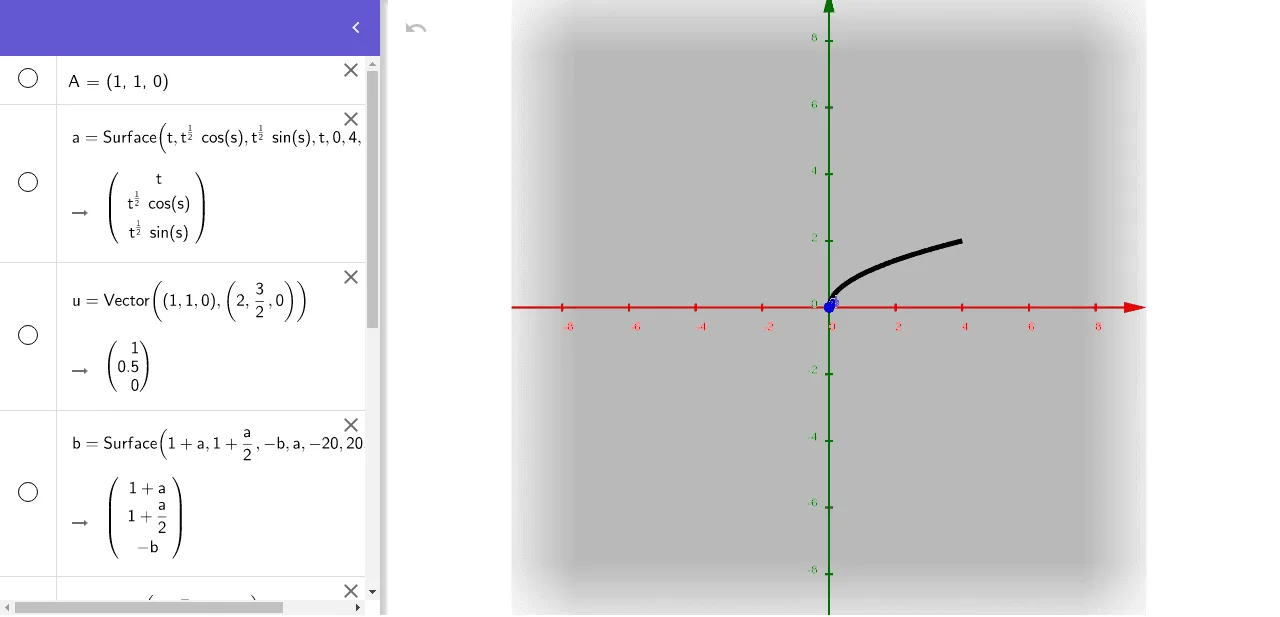
This example demonstrates the construction of a tangent plane to a surface of revolution. It involves core mathematical concepts such as surfaces, vectors, derivatives, and coordinate geometry. The construction uses commands like Surface, Vector, CurveCartesian, and Line in GeoGebra. Suitable for high school and above students to understand the relationship between rotating surfaces and tangent planes.
GeoGebra Commands & Parameters
Surface(t, (t^(1 / 2) * cos(s)), (t^(1 / 2) * sin(s)), t, 0, 4, s, 0, (2 * π)) → aVector((1, 1, 0), (2, 3 / 2, 0)) → uSurface(1 + a, 1 + a / 2, (-b), a, -20, 20, b, -20, 20) → bCurveCartesian(t, sqrt(t), 0, t, 0, 4) → cLine((0, 0, 0), (2, 0, 0)) → fSurface(c, m, f) → dVector((1, 1, 0), (1, 1, 1)) → v
AI Drawing Prompt Reference
Draw a surface of revolution formed by rotating a parabolic curve around a vertical axis, creating a bowl-like shape. At a point on this surface, construct a tangent plane determined by two intersecting tangent lines: one along the generating curve and one along the circular cross-section. Add a vertical vector at that point representing the normal direction, and include a horizontal axis line from the origin, plus a horizontal tangent vector from the point. Show the spatial relationship among the surface, tangent plane, normal vector, and rotation axis.
The prompt above was compiled from the original drawing commands and is for reference only.