
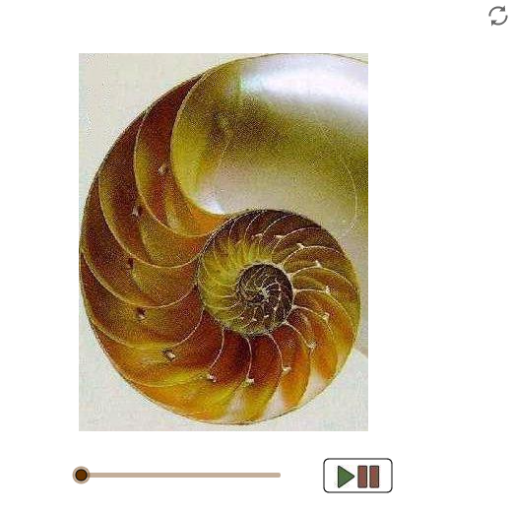
Gnomonic Growth of the Nautilus
Loading the math board and drawing, please wait…
In collections
Logarithmic Spiral and Fibonacci Numbers
This example illustrates the gnomonic growth of a nautilus shell. Key mathematical concepts include similarity transformation, vectors, parametric curves, and complex numbers. Using GeoGebra commands such as Segment, Rotate, Angle, Ray, Circle, Intersect, and Polygon, the growth trajectory of the nautilus shell is constructed. Suitable for high school mathematics education and research.
GeoGebra Commands & Parameters
Segment(A, B) → fRotate(A, (-δ), B) → A'Angle(A', B, A) → αRotate(B, ζ, A) → B'Angle(B, A, B') → βRay(A, B') → gRay(B, A') → hCircle(A, a) → c_2Intersect(c_2, g) → D,Circle(B, b) → d_1Intersect(d_1, h) → C,Rotate(C, β, D) → C'Ray(D, C') → jPolygon(A1) → C1Rotate(D, (-α), C) → D'Angle(D', C, D) → γRotate(C, β, D) → C'_1Angle(C, D, C'_1) → εRay(C, D') → iRay(D, C'_1) → kCircle(C, (Distance[B, C] * B1)) → cCircle(D, (Distance[A, D] * B1)) → dPolygon(A2) → C2Polygon(A3) → C3Polygon(A4) → C4Polygon(A5) → C5Polygon(A6) → C6Polygon(A7) → C7Polygon(A8) → C8Polygon(A9) → C9Polygon(A10) → C10Polygon(A11) → C11Polygon(A12) → C12Polygon(A13) → C13Polygon(A14) → C14Polygon(A15) → C15Polygon(A16) → C16Polygon(A17) → C17Polygon(A18) → C18Polygon(A19) → C19Polygon(A20) → C20Polygon(A21) → C21Polygon(A22) → C22Polygon(A23) → C23Polygon(A24) → C24Polygon(A25) → C25Polygon(A26) → C26Polygon(A27) → C27Polygon(A28) → C28Polygon(A29) → C29Polygon(A30) → C30Polygon(A31) → C31Polygon(A32) → C32Polygon(A33) → C33Polygon(A34) → C34Polygon(A35) → C35Polygon(A36) → C36