
Gigantotron Similarity Demo
Loading the math board and drawing, please wait…
In collections
Transformations
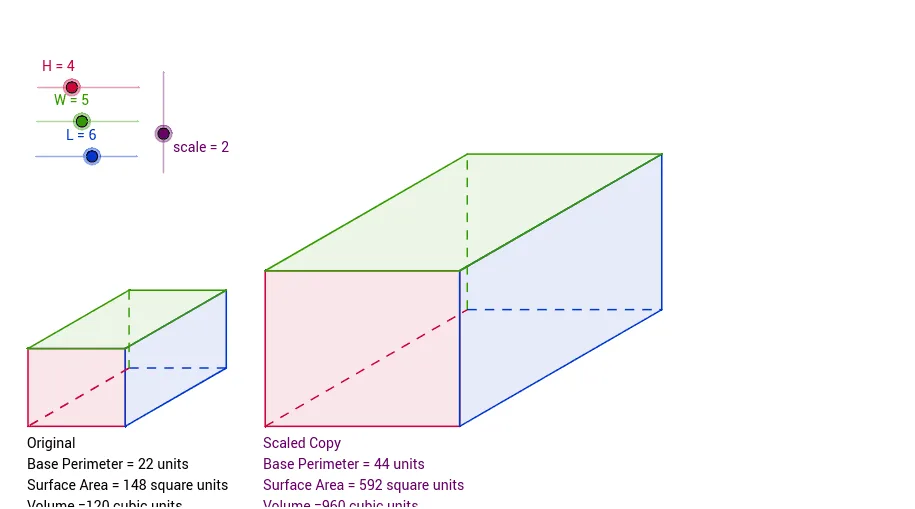
This example demonstrates the principles of geometric similarity, prism volume, and surface area calculations. Core math concepts include area, volume, equations, arithmetic operations, isosceles triangles, trapezoids, and geometric transformations. Construction involves commands like Line, OrthogonalLine, Rotate, Circle, Intersect, Polygon, Segment, and objects such as A, B, a, b, b', H, W, L, c, d, e, C, D, E, f, g, i, j, k, l, F, G, m, H_1, n, I, poly1, a_1, c_1, f_1, d_1, poly2, d_2, g_1, i_1, f_2, poly3, c_2, f_3, i_2. Suitable for high school students and teachers for solid geometry, similarity, and computational lessons.
GeoGebra Commands & Parameters
Line(A, B) → aOrthogonalLine(A, a) → bRotate(b, 30*°, A) → b'Circle(A, H) → cCircle(A, W) → dCircle(A, L) → eIntersect(c, a, 2) → CIntersect(d, b, 1) → DIntersect(e, b', 1) → EOrthogonalLine(C, a) → fOrthogonalLine(D, b) → gOrthogonalLine(E, a) → iLine(D, b') → jLine(E, a) → kLine(C, b') → lIntersect(f, g) → FIntersect(i, j) → GLine(G, a) → mIntersect(k, l) → H_1Line(F, b') → nIntersect(m, n) → IPolygon(A, C, F, D) → poly1, a_1, c_1, f_1, d_1Polygon(D, G, I, F) → poly2, d_2, g_1, i_1, f_2Polygon(C, F, I, H_1) → poly3, c_2, f_3, i_2, h_1Segment(G, E) → pSegment(H_1, E) → qSegment(E, A) → rLine(A, D) → hOrthogonalLine(G, h) → sIntersect(h, s) → JCircle(J, 2) → tIntersect(t, h, 2) → KLine(A, D) → b_1OrthogonalLine(K, b_1) → e_1Line(K, d_2) → j_1Circle(K, scale * H) → k_1Circle(K, scale * W) → p_1Circle(K, scale * L) → q_1Intersect(k_1, e_1, 2) → MIntersect(p_1, b_1, 2) → NIntersect(q_1, j_1, 2) → OLine(N, e_1) → l_1Line(M, b_1) → m_1Line(N, j_1) → n_1Line(O, e_1) → r_1Line(M, j_1) → s_1Intersect(l_1, m_1) → PIntersect(r_1, s_1) → QLine(Q, b_1) → a_2Polygon(K, N, P, M) → poly4, k_2, n_2, p_2, m_2Segment(K, O) → b_2Segment(O, Q) → e_2Line(N, h_1) → t_1Line(O, k_2) → g_2Line(Q, g_2) → h_2Intersect(t_1, g_2) → RLine(R, n_2) → j_2Intersect(h_2, j_2) → SPolygon(N, R, S, P) → poly5, n_3, r_2, s_2, p_3Polygon(S, Q, M, P) → poly6, s_3, q_2, m_3, p_4Segment(O, R) → l_2
AI Drawing Prompt Reference
Draw a 3D geometric figure with three similar quadrilaterals. Start by drawing a line segment AB, then construct a line b perpendicular to AB, and rotate b to get b'. Draw three circles with radii H, W, and L centered at A, and find points C, D, and E by intersecting these circles with line a and b. Construct perpendicular lines f, g, and i from C, D, and E, and lines j, k, and l from D, E, and C, then find points F, G, and H_1 by intersecting these lines. Finally, construct quadrilaterals ACFD, DGIF, and CFIH_1.
The prompt above was compiled from the original drawing commands and is for reference only.