
Geometry 3.3: Proving Lines Parallel – Slope and Angle Exploration
Loading the math board and drawing, please wait…
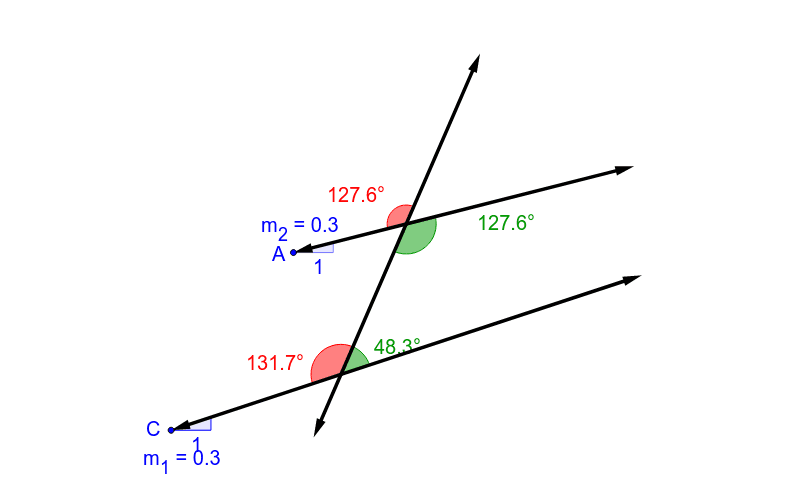
①This example demonstrates how changing angle measures affects the slopes of two lines, visually connecting the geometric condition for parallel lines (equal corresponding angles) with algebraic slope values. ②Core math concepts include slope, parallel line theorems, the tangent function linking angles to slopes, and angle relationships in triangles. ③Construction highlights: using GeoGebra commands Line, Intersect, Angle, Slope, Vector, and Point; objects include lines a, b, c, points A through I, angles α, β, γ, δ, ε, slopes m_1 and m_2, and vectors u, v, w, z. ④Targeted at middle-to-high school geometry students, this interactive activity supports dynamic exploration of parallel line criteria and can be used for guided discovery or classroom demonstration.
GeoGebra Commands & Parameters
Line(A, B) → aLine(C, D) → bLine(E, F) → cIntersect(b, c) → GIntersect(a, c) → HAngle(G, H, B) → βSlope(a) → m_2Slope(b) → m_1Angle(E, H, A) → γAngle(F, G, D) → δVector(G, C) → uVector(G, D) → vVector(H, A) → wVector(H, B) → zPoint(c) → IVector(H, I) → dVector(H, F) → eAngle(H, G, C) → αAngle(D, G, H) → ε
AI Drawing Prompt Reference
Draw two lines intersected by a transversal, creating two intersection points. Place a point on the transversal and connect it to points on the two lines to form triangles. Label the corresponding angles formed by the transversal and the two lines, as well as angles inside the triangles. Display the slopes of the two lines numerically, and use arrow vectors from the intersection points to other points to show directions. Include a slider to adjust angle measures, allowing observation of slope changes and verification that equal corresponding angles imply parallel lines.
The prompt above was compiled from the original drawing commands and is for reference only.