
Geometric Representation of Two-Note Combinations in Music Theory
Loading the math board and drawing, please wait…
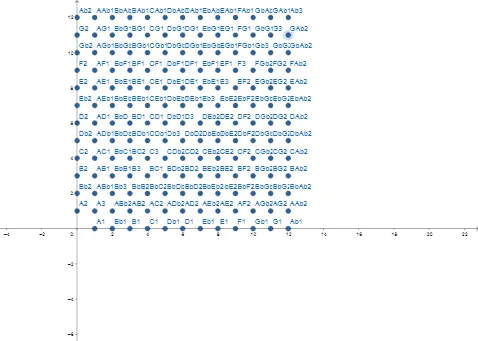
① This example demonstrates how music theory for two-note combinations can be represented geometrically, mapping intervals to points and polygons in the plane. ② Core mathematical concepts include set theory (note sets), geometric transformations (translation/symmetry of intervals), isosceles triangles (symmetric interval relationships), and polygon construction. ③ Construction details: Using GeoGebra's Polygon command to create multiple triangles (e.g., A1A2A3, Bb1Bb2Bb3), each representing a two-note combination; PointIn command marks note points, and numerous named objects (C1, D2, Eb3, etc.) correspond to different pitches, forming a systematic interval mapping. ④ Suitable for high school or college interdisciplinary teaching of music theory and mathematics, exploring connections between geometry and musical structure, and stimulating interest in abstract mathematical concepts.
GeoGebra Commands & Parameters
Polygon(A2, A1, A3) → t1, a3, a2, a1Polygon(Bb2, Bb1, Bb3) → t2, bb3, bb2, bb1Polygon(B2, B1, B3) → t3, b3, b2, b1Polygon(C2, C1, C3) → t4, c3, c2, c1Polygon(Db2, Db1, Db3) → t5, db3, db2, db1Polygon(D2, D1, D3) → t6, d3, d2, d1Polygon(Eb2, Eb1, Eb3) → t7, eb3, eb2, eb1Polygon(E2, E1, E3) → t8, e3, e2, e1Polygon(F2, F1, F3) → t9, f3, f2, f1Polygon(Gb2, Gb1, Gb3) → t10, gb3, gb2, gb1Polygon(G2, G1, G3) → t11, g3, g2, g1Polygon(Ab2, Ab1, Ab3) → t12, ab3, ab2, ab1Polygon(ABb1, ABb2, Bb1, A1, A2, Bb2) → poly1, f, g, h, i, j, kPolygon(A2, A1, B1, AB2, B3, AB1, B2) → poly2, l, m, n, p, q, r, sPolygon(A1, C1, AC2, C3, AC1, C2, A2) → poly3, t, a, ac2, b, ac1, c, dPolygon(A1, Db1, ADb2, Db3, ADb1, Db2, A2) → poly4, e, f_1, adb2, g_1, adb1, h_1, i_1Polygon(A1, D1, AD2, D3, AD1, D2, A2) → poly5, j_1, k_1, ad2, l_1, ad1, m_1, n_1PointIn(poly5) → Pointpoly5_{1}PointIn(poly5) → Pointpoly5_{2}PointIn(poly5) → Pointpoly5Polygon(ABb1, A3, ABb2, Bb3) → q1, abb1, p_1, abb2, q_1Polygon(AB1, A3, AB2, B3) → q2, r_1, s_1, t_1, a_1Polygon(AC1, A3, AC2, C3) → q3, b_1, c_1, d_1, e_1Polygon(ADb1, A3, ADb2, Db3) → q4, f_2, g_2, h_2, i_2Polygon(AD1, A3, AD2, D3) → q5, j_2, k_2, l_2, m_2
AI Drawing Prompt Reference
Draw a geometric composition of multiple triangles and hexagons, where each triangle represents a two-note interval with vertices labeled by pitch names (e.g., C, D, E) including sharps and flats. Arrange the triangles symmetrically around a central point to form a star-like pattern. Connect adjacent triangle vertices with hexagons, and place several random points inside one hexagon. Use distinct colors for different pitch regions to illustrate the mapping between musical intervals and geometric shapes.
The prompt above was compiled from the original drawing commands and is for reference only.