
Geometric Representation of Roots of Unity by Judah L Schwartz
Loading the math board and drawing, please wait…
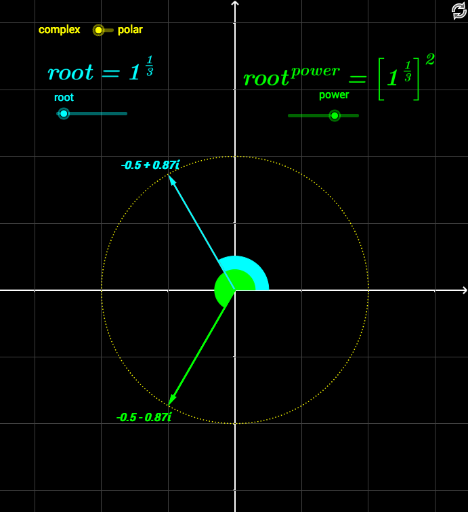
This example demonstrates the geometric representation of roots of unity in the complex plane. It involves core mathematical concepts such as complex numbers, trigonometry, and geometric transformations. Key construction elements include GeoGebra commands and objects like Intersect (intersection), Circle (circle), Rotate (rotation), Angle (angle), ToComplex (complex conversion), ToPolar (polar conversion), and Vector (vector). Suitable for high school and above mathematics learners to understand complex number operations and geometric significance.
GeoGebra Commands & Parameters
Intersect(xAxis, yAxis) → ACircle(A, 1) → cRotate(C, (360 / root)°, A) → NrootAngle(C, A, Nroot) → α_1ToComplex(Vector[Nroot]) → uToPolar(Vector[Nroot]) → vVector(NrootPower) → wToPolar(w) → zAngle(C, A, NrootPower) → β_1ToComplex(w) → a
AI Drawing Prompt Reference
Draw a unit circle centered at the origin in the complex plane. Mark a point on the positive real axis as the starting point. Rotate this point around the origin by equal angular steps to generate several points evenly spaced on the circle, representing roots of unity. Draw vectors from the origin to these points)Skip. Label the angle between the starting point, origin, and each rotated point. Also, convert one of the rotated vectors to polar form and display its magnitude and direction with an arrow. The diagram should clearly show the geometric representation of complex numbers, including the unit circle, equally spaced points, vectors, and angle labels.
The prompt above was compiled from the original drawing commands and is for reference only.