
Geometric Representation of Complex Zeros of Quadratic Functions
Loading the math board and drawing, please wait…
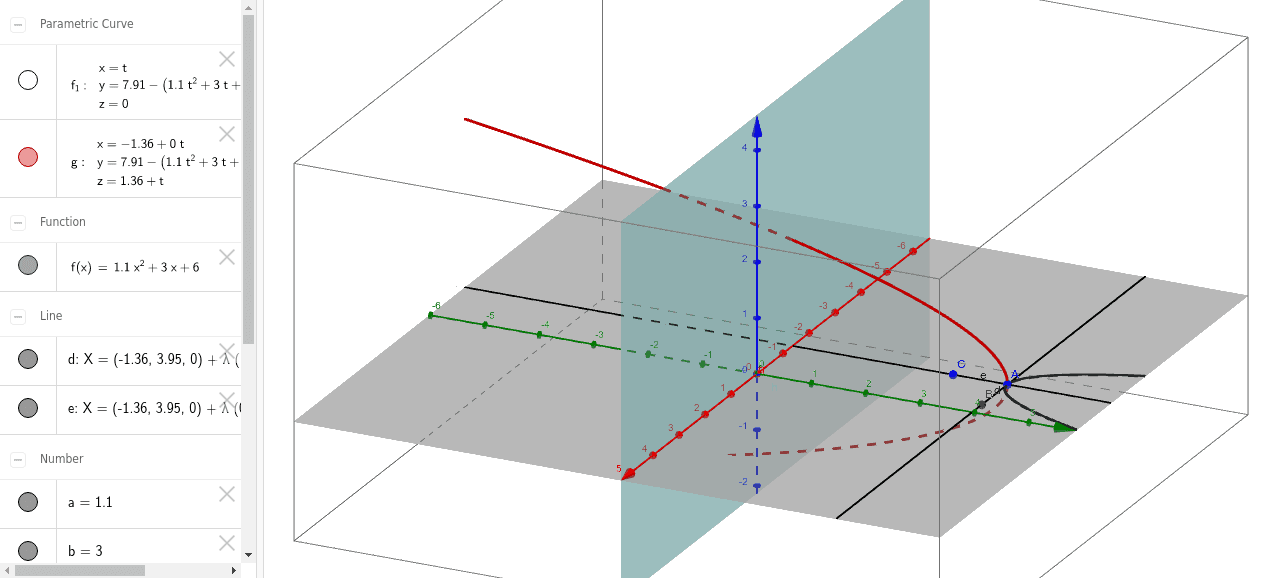
This GeoGebra example demonstrates how to visually represent complex roots of quadratic functions on the complex plane. By inputting coefficients for a quadratic function, the applet plots the function graph and uses complex number tools to find its conjugate complex zeros. Core mathematical concepts include: quadratic formula, geometric representation of complex numbers (conjugate symmetry), complex modulus and argument. Construction uses: Line command for coordinate axes, Mirror command to reflect zeros across the real axis to obtain conjugate complexes, Rotate command to illustrate argument relationships. Objects include: a, b, c as quadratic coefficients, f as function graph, A, B as zero points, d, e as auxiliary lines, g, h as transformed geometric elements. Suitable for high school or pre-university students learning complex numbers and their geometric interpretations, as well as teachers demonstrating the geometric meaning of complex roots.
GeoGebra Commands & Parameters
Line(A, B) → dMirror(f, d) → f_1Line(A, C) → eRotate(f_1, 90*°, e) → g