
Geometric Representation of Complex Roots by Wendy Fresh
Loading the math board and drawing, please wait…
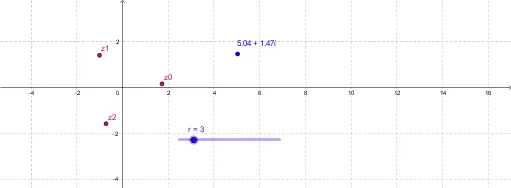
This example dynamically demonstrates the distribution and geometric significance of complex roots in the complex plane. It involves core mathematical concepts such as complex numbers, modulus, argument, complex roots, and geometric transformations. The construction uses commands like Angle and Length, along with objects like i (imaginary unit), z (complex number), r (modulus), α (argument), a (real part), and z0-z8 (complex root points). It is suitable for high school mathematics education to understand the connection between complex operations and geometric representations.
GeoGebra Commands & Parameters
Angle(z) → αLength(z) → a
AI Drawing Prompt Reference
In the complex plane, draw a vector from the origin to a complex number point, with its real part on the horizontal axis and imaginary part on the vertical axis. Project this vector onto the real axis with a dashed line and label its length. Draw an arc from the positive real axis to the vector to indicate the argument (angle) of the complex number, and label this angle. Then, using the origin as center and the modulus (length of the vector) as radius, draw a circle. On this circle, mark eight equally spaced points representing the complex roots of the original number, with equal angular intervals between adjacent points. Label these root points and connect them in order to form a regular octagon, illustrating the geometric symmetry of complex roots.
The prompt above was compiled from the original drawing commands and is for reference only.