
Geometric Representation of Complex Number i and Its Relationship with the Unit
Loading the math board and drawing, please wait…
In collections
Complex Math
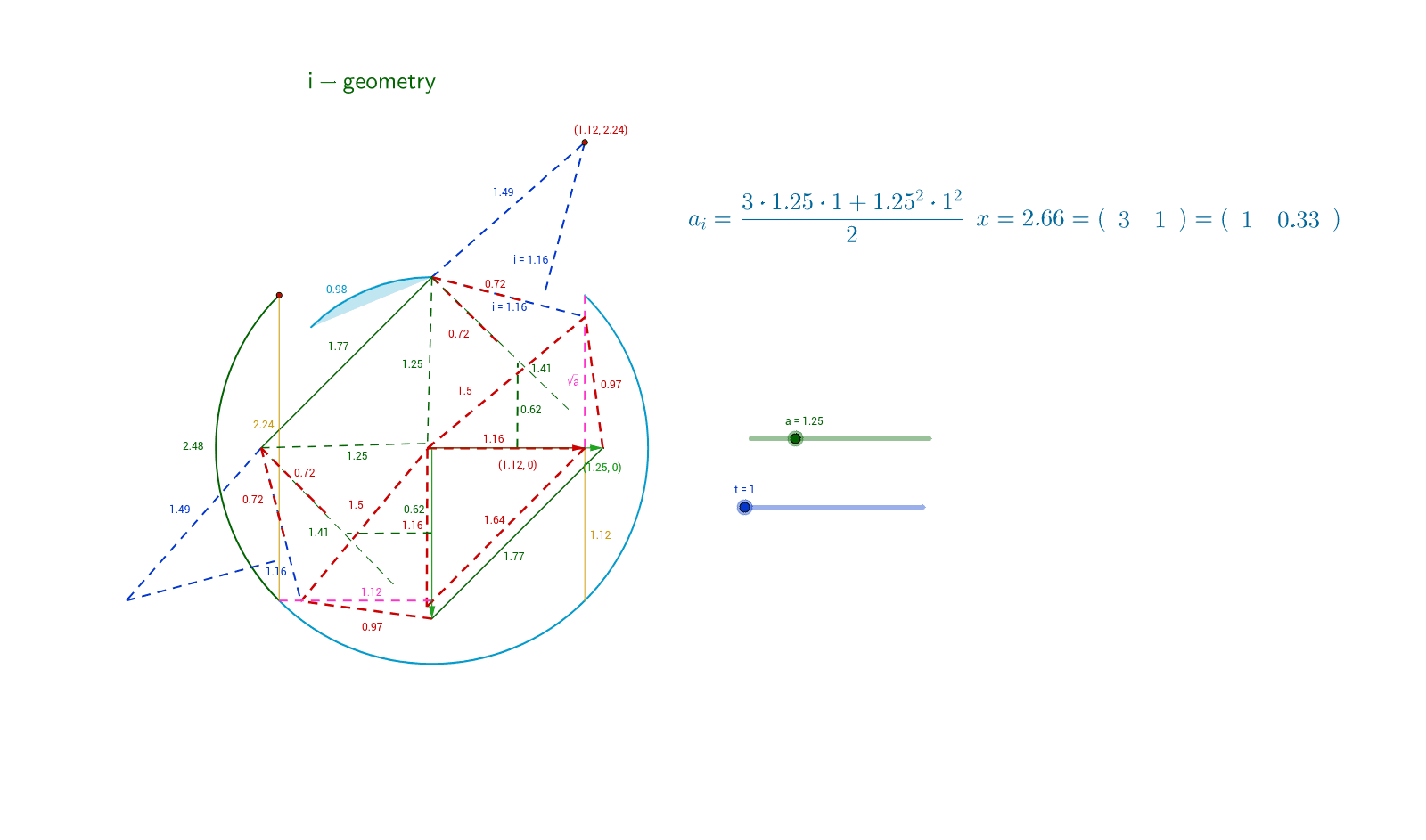
This GeoGebra applet dynamically demonstrates the geometric representation of the imaginary unit i on the complex plane, exploring the intrinsic relationship between i and the unit circle. Key mathematical concepts include vector representation of complex numbers, geometric properties of the unit circle, and the geometric interpretation of complex arithmetic operations. Construction highlights: Based on the construction summary, this applet comprehensively employs Vector commands for plotting complex vectors, Circle for constructing the unit circle, CircleArc to illustrate radian relationships, Angle to mark key angles, Intersect to determine intersections between vectors and the circle, Point for marking critical positions, Segment to connect relevant points, Polygon for constructing auxiliary figures, and Mirror for symmetry transformations. Suitable for high school and university mathematics classrooms to demonstrate the connection between complex numbers and trigonometry, as well as for inquiry-based learning exploring the geometric meaning of complex numbers.
GeoGebra Commands & Parameters
Vector((0, 0), (1, 0)) → uVector((0, -0.007890188248790508), (a^(0.5), a^(0.5))) → dVector((0, 0), ((-a^(0.5)), (-a^(0.5)))) → eVector((0, 0), (a^(0.5), (-a^(0.5)))) → fVector((0, 0), ((-a^(0.5)), a^(0.5))) → gPoint(b) → CPoint(v) → DPoint(w) → EPoint(c) → FPoint(d) → GPoint(e) → HPoint(g) → IPoint(f) → JPoint(f) → KLine(G, w) → hPoint(v) → LVector((0, 0), (a^(0.5), 0)) → iPoint(i) → MSegment(M, G) → jSegment(D, E) → kSegment(E, C) → lSegment(C, F) → mSegment(F, D) → nSegment(G, I) → pSegment(I, H) → qSegment(H, J) → rSegment(J, M) → sPoint(k) → ADistance(K, A) → distanceKADistance(G, K) → distanceGKPoint(v) → BDistance(B, A) → distanceBASegment(B, A) → t_xCircle(K, H) → c_1Circle(K, C) → d_1Segment(I, J) → a_1Mirror(e, a_1) → e'Mirror(M, p) → M'Mirror(G, p) → G'Segment(M', G') → j'Distance(M, M') → distanceMM'Polygon(K, E, A) → poly1, a_2, k_1, e_2Point(d_1) → NPoint(d_1) → OSegment(N, O) → b_1Factors(o) → matrix1ReducedRowEchelonForm(matrix1) → matrix2Segment(E, M') → h_1Point(Circle[E, 1.16]) → PSegment(E, P) → g_1Point(Circle[P, 1.16]) → QSegment(P, Q) → i_1Point(Circle[E, 1.64]) → RSegment(E, R) → j_1Angle(M', E, R) → αPoint(Circle[M', 1.16]) → SSegment(M', S) → l_1Point(Circle[E, 1.16]) → TSegment(E, T) → m_1CircleArc(K, I, H) → p_1CircleArc(K, H, G) → e_1CircleArc(K, E, I) → q_1Intersect(j', h_1) → VPoint(Circle[M, 1.64]) → WSegment(M, W) → r_1Point(Circle[W, 1.16]) → ZSegment(W, Z) → s_1Point(Circle[Z, 1.16]) → A_1Segment(Z, A_1) → t_1Segment(T, V) → b_2Segment(D, T) → c_2Point(m_1) → B_1Segment(E, B_1) → d_2Segment(Z, T) → f_2Polygon(E, T, Z) → poly2, z_1, e_3, t_2Polygon(D, W, Z, T) → poly3, d_3, w_1, z_2, t_3Intersect(t_x, k_1) → C_1Point(Circle[E, 0.72]) → D_1Segment(E, D_1) → h_2Point(t_x) → E_1Point(Circle[E, 1.41]) → F_1Segment(E, F_1) → i_2Segment(E, Z) → j_2Mirror(E, k_2) → E'Mirror(M', k_2) → M''Segment(E', M'') → l_2Mirror(M', k_2) → M''_1Mirror(S, k_2) → S'Segment(M''_1, S') → m_2Mirror(M', k_2) → M''_2Mirror(G', k_2) → G''Segment(M''_2, G'') → j''Mirror(D, k_2) → D'Mirror(T, k_2) → T'Segment(D', T') → n_2Mirror(Z, k_2) → Z'Mirror(T, k_2) → T'_1Segment(Z', T'_1) → p_2Mirror(E, k_2) → E'_1Mirror(Z, k_2) → Z'_1Segment(E'_1, Z'_1) → q_2Mirror(B, k_2) → B'Mirror(A, k_2) → A'Segment(B', A') → r_2Mirror(E, k_2) → E'_2Mirror(F_1, k_2) → G_1Segment(E'_2, G_1) → s_2Mirror(M, k_2) → M'_1Mirror(G, k_2) → G'_1Segment(M'_1, G'_1) → j'_1Mirror(W, k_2) → W'Mirror(D, k_2) → D'_1Mirror(W, k_2) → W'_1Mirror(Z, k_2) → Z'_2Mirror(E, k_2) → E'_3Mirror(T, k_2) → T'_2Segment(E'_3, T'_2) → g_2Mirror(E, k_2) → E'_4Mirror(B_1, k_2) → H_1Segment(E'_4, H_1) → a_3Point(s_2) → I_1Point(i_2) → J_1Segment(I_1, J_1) → b_3Mirror(E, k_2) → E'_5Mirror(D_1, k_2) → K_1Segment(E'_5, K_1) → c_3
AI Drawing Prompt Reference
Draw the geometric representation of the imaginary unit i on the complex plane, including the unit circle and vectors. Start by drawing the unit vector u on the real axis, then draw the complex vectors d, e, f, and g, and mark the key points C, D, E, F, G, H, I, J, K, L, and M. Using these vectors and points, construct the unit circles c_1 and d_1, and auxiliary segments and polygons to illustrate the relationship between complex numbers and the unit circle.
The prompt above was compiled from the original drawing commands and is for reference only.