
Geometric Properties and Constructions of Parallelograms and Rectangles
Loading the math board and drawing, please wait…
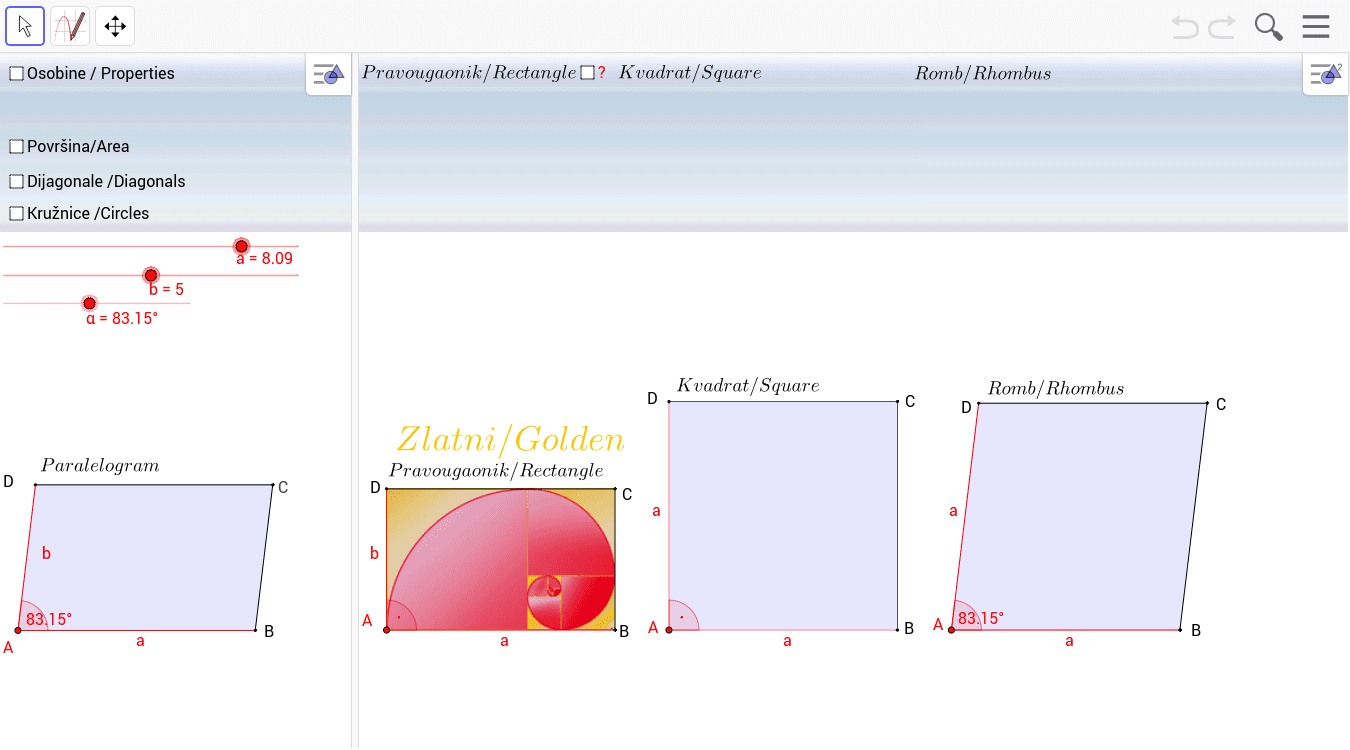
This GeoGebra example dynamically demonstrates the geometric constructions, classifications, and core properties of parallelograms, rectangles, rhombuses, and squares. Key mathematical concepts include side and angle relationships, area and perimeter formulas, diagonal intersections (orthogonality and bisection), and circumcircles/incircles. To construct these shapes, the applet utilizes core GeoGebra commands including Point, Segment, Rotate, Angle, Line, Intersect, OrthogonalLine, Polygon, and Circle, driven by parameters a, b, alpha and vertices A, B, C, D to show the transition from general parallelograms to rectangles and squares. It is highly suitable for secondary school geometry lessons, university-level introductory courses, or self-paced mathematical exploration.
GeoGebra Commands & Parameters
Point(Circle[A, a]) → BSegment(A, B) → ABPoint(Circle[A, b]) → DpomocnaSegment(A, Dpomocna) → b'pomocniRotate(Dpomocna, α, A) → DAngle(Dpomocna, A, D) → α_1Segment(A, D) → AD_1Line(D, AB) → laLine(B, AD_1) → lbIntersect(la, lb) → CLine(A, B) → lABOrthogonalLine(D, lAB) → n_aIntersect(n_a, lAB) → ESegment(D, E) → h_aPolygon(A, B, C, D) → Paralelogram, a_0, b_0, c_0, d_0Polygon(A_2, B_2, C_2, D_2) → Pravougaonik, a_2, b_2, c_2, d_2Angle(B_2, A_2, D_2) → αPPolygon(A_3, B_3, C_3, D_3) → Kvadrat, a_3, b_3, c_3, d_3Polygon(A_4, B_4, C_4, D_4) → Romb, a_4, b_4, c_4, d_4Angle(B_3, A_3, D_3) → αKAngle(B_4, A_4, D_4) → αRSegment(D_4, Er_1) → hSegment(A, C) → ACSegment(B, D) → BDIntersect(AC, BD) → OSegment(B_2, D_2) → dpSegment(A_2, C_2) → dp_1Intersect(dp, dp_1) → O_1Segment(D_3, B_3) → dkSegment(A_3, C_3) → dk_1Segment(A_4, C_4) → dr1Segment(B_4, D_4) → dr2Intersect(dr2, dr1) → O_3Intersect(dk_1, dk) → O_2Circle(O_1, A_2) → k_pCircle(O_3, h / 2) → k_rSegment(O_1, B_2) → r_pIntersect(k_r, a_4) → Er_2,Segment(O_3, Er_2) → r_rCircle(O_2, dk / 2) → k_oCircle(O_2, a / 2) → k_uSegment(O_2, B_3) → r_oIntersect(k_u, a_3) → Ek,Segment(O_2, Ek) → r_uOrthogonalLine(D, lb) → n_bIntersect(lb, n_b) → FSegment(D, F) → h_bPoint(lAB) → A_1Point(la) → D_1Polygon(A_1, B_1, C_1, D_1) → P, a_1, b_1, c_1, d_1Segment(D_1, E_0) → ha_0Angle(D, C, B) → γAngle(C, B, A) → βAngle(A, D, C) → δAngle(B_4, O_3, C_4) → αRdSegment(O_3, C_4) → dr1pSegment(B_4, O_3) → dr2pAngle(B_4, A_4, O_3) → αR_1Angle(O_3, A_4, D_4) → αR_2