
Geometric Modeling of Circular Orbits with Animation
Loading the math board and drawing, please wait…
In collections
El dominio del Tiempo (cinemática intuitiva)
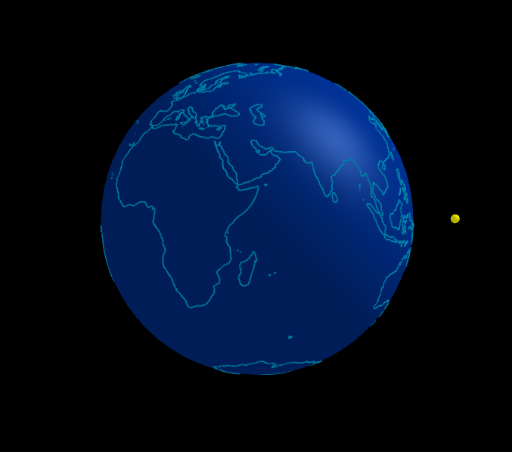
This example demonstrates, through an animation, how a point’s position evolves along a circular orbit and how the underlying geometric relationships remain consistent as parameters change. Key concepts include circle properties, metric relationships derived from similar triangles and the Pythagorean theorem, and a parameter-based construction that links orbit radius and position. Construction highlights: Sphere is used to set up a 3D reference scene (e.g., a “tierra” object), Circle constructs the orbit itself, and If supports conditional resets/logic during the animation. The mean command is used to compute intermediate/average quantities that feed into the geometry. Time-parameter objects such as t, dt, t0, t1, ω/ω1, vueltas, reg, regDif, T, and vel drive the moving point (M1) and the evolution of its trajectory; axes (eje1) and text/labels (texto5, tPausa) provide readable guidance and control. Suitable for secondary to early college geometry/coordinate-geometry lessons and for teaching how parameterized motion connects to classical geometric measures.
GeoGebra Commands & Parameters
Sphere((0, 0, 0), (0.999 * 5)) → tierraIf(Length[reg] ≟ 1, {reg(1)}, Sequence[reg(k) - reg(k + 1), k, 1, Length[reg] - 1]) → regDifmean(regDif) → TCircle((0, 0, 0), d1, eje1) → c
AI Drawing Prompt Reference
Create a three-dimensional geometric scene showing an animation of a point moving along a circular orbit. Set up a reference sphere centered at the origin in 3D space, construct a circular orbit path driven by time parameters so that a moving point travels continuously around the circle. The animation should demonstrate parameterized motion characteristics including velocity variations and periodic trajectories. Include coordinate axes as reference elements and text labels explaining motion parameters such as angular velocity and period. The overall presentation reflects geometric metric relationships derived from similar triangles and the Pythagorean theorem, demonstrating the combination of circle properties with parametric construction.
The prompt above was compiled from the original drawing commands and is for reference only.