
Geometric Interpretation of Complex Number Multiplication
Loading the math board and drawing, please wait…
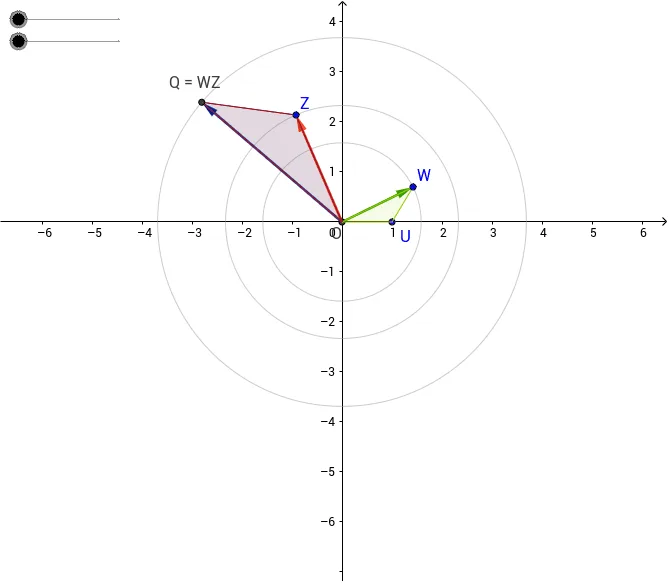
This example demonstrates the geometric interpretation of complex number multiplication. By constructing the geometric representation of complex number multiplication, one can intuitively understand the properties of complex number multiplication. It uses commands such as Vector, Circle, and Polygon in GeoGebra. Suitable for high school math education and students learning complex number multiplication.
GeoGebra Commands & Parameters
Intersect(xAxis, yAxis) → OVector(O, W) → WvecVector(O, Z) → ZvecVector(O, Q) → QvecCircle(O, Z) → zCircle(O, W) → wPolygon(W, O, U) → WOU, ZO, OU, UZPolygon(Q, O, Z) → QOZ, QO, OW, WQDilate(Rotate[Z, -r * Angle[Z], O], 1 + s * (abs(W) / abs(Q) - 1), O) → Z'Dilate(Rotate[Q, -r * Angle[Z], O], 1 + s * (abs(W) / abs(Q) - 1), O) → Q'Polygon(Q', O, Z') → QOZ', QO', OW', WQ'Circle(O, Q) → q
AI Drawing Prompt Reference
Draw a geometric representation of complex number multiplication in a coordinate plane. Start with the origin O, points W and Z, and vectors from O to W and O to Z, labeled Wvec and Zvec. Draw circles centered at O with radii Z and W, labeled z and w. Create triangles WOU and ZO connecting W, O, and U, and QOZ connecting Q, O, and Z. Then, dilate and rotate points Q and Z to obtain Q' and Z'. Finally, draw triangle QOZ' connecting Q', O, and Z', and a circle centered at O with radius Q, labeled q. This illustrates the geometric interpretation of complex number multiplication.
The prompt above was compiled from the original drawing commands and is for reference only.