
Geometric Illustration of Complex Number Roots
Loading the math board and drawing, please wait…
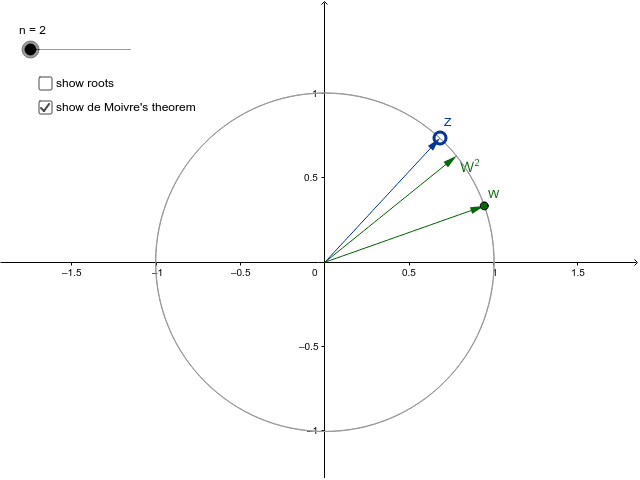
This example demonstrates the geometric construction of n-th roots of a complex number using De Moivre's theorem. Key concepts include complex number operations, trigonometric representation, and geometric transformations. The construction uses GeoGebra commands like Intersect, Circle, and Vector to visualize root trajectories. Suitable for high school students or university courses in complex analysis.
GeoGebra Commands & Parameters
Intersect(xAxis, yAxis) → OSequence(Z^(1 / n) * exp(i * 2 * 3.141592653589793 * k / n), k, 0, n - 1) → RootsCircle(O, Z) → ZCircleVector(O, Z) → ZVectorCircle(O, abs(ZVector)^(1 / n)) → WCirclePoint(WCircle) → WSequence(Text["W^{" + (k) + "}", W^(k), n > 0, n > 0], k, 2, n) → WLabelsSequence(Vector[O, W^(k)], k, 1, n) → WVectorsSequence(Text["W_{" + (k) + "}", Element[Roots, k], n > 0, n > 0], k, 1, n) → RootsLabelsSequence(Vector[O, Element[Roots, k]], k, 1, n) → RootsVectorsSequence(Circle[O, abs(W^(k))], k, 2, n - 1) → WCircles
AI Drawing Prompt Reference
Draw a geometric construction showing the n-th roots of a complex number, centering at the origin with a circle representing the complex number, marking n equal divisions on the circle, connecting each division to the origin, and drawing smaller circles centered at each division point, labeling each root on the main circle with its index and connecting each root to the origin to visualize the geometric meaning of complex number roots.
The prompt above was compiled from the original drawing commands and is for reference only.