
Geometric Construction of Vector Sum (Somma di Vettori)
Loading the math board and drawing, please wait…
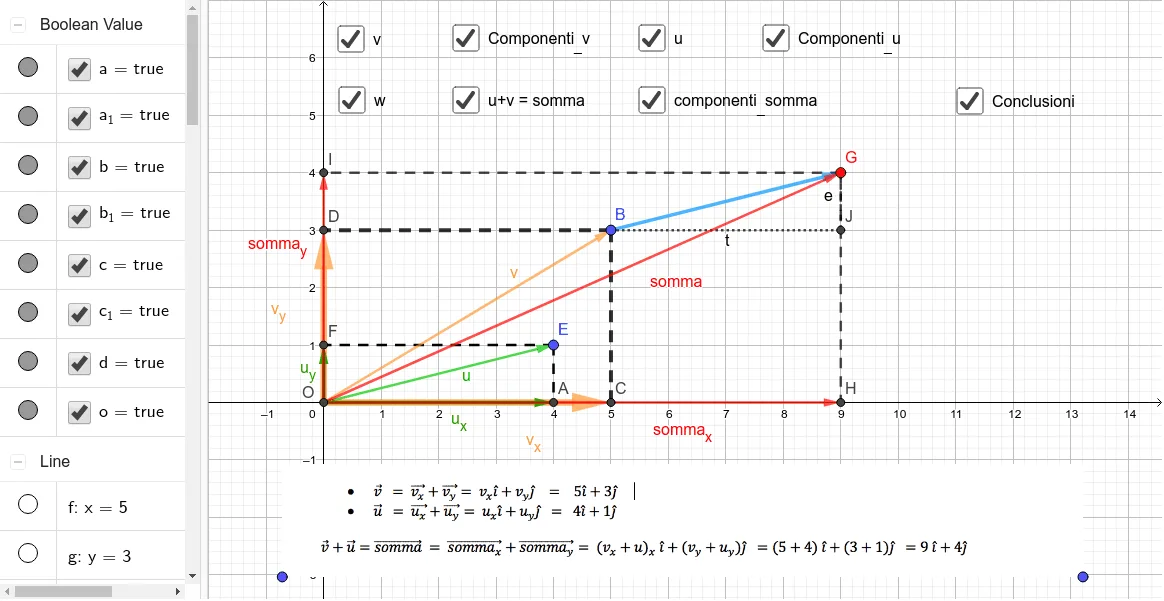
This example demonstrates how to obtain the sum of vectors through a geometric construction, visually confirming the resulting vector’s direction and position on the plane. The main mathematical ideas are vector representation (including direction and component meaning), vector addition via composition (the “head-to-tail” interpretation), and deriving components using perpendicular auxiliary lines and intersection points. Construction highlights in GeoGebra: Vector is used to create the involved vectors, Segment is used to show the vector-carrying line segments, OrthogonalLine provides perpendicular helper lines used to separate components, and Intersect determines the key points where those helper lines meet. From the construction objects and names (e.g., the vectors v and u, component-related points like vx_1/vy_1 and ux_1/uy_1, and the final object somma), the diagram emphasizes how the component-wise geometry leads to the composed (summed) vector. Suitable for upper secondary school through early university coursework, especially for lessons on vector basics and geometric construction with vector components.
GeoGebra Commands & Parameters
Intersect(xAxis, yAxis) → OVector(O, B) → vOrthogonalLine(B, xAxis) → fOrthogonalLine(B, yAxis) → gIntersect(f, xAxis) → CIntersect(yAxis, g) → DVector(O, C) → v_xVector(O, D) → v_ySegment(B, C) → hSegment(B, D) → iVector(O, E) → uOrthogonalLine(E, v_x, xOyPlane) → jOrthogonalLine(E, v_y, xOyPlane) → kIntersect(j, xAxis) → AIntersect(k, yAxis) → FSegment(E, A) → lSegment(E, F) → mVector(B, G) → wVector(O, G) → sommaVector(O, F) → u_yOrthogonalLine(G, xAxis) → nOrthogonalLine(G, yAxis) → pIntersect(n, xAxis) → HIntersect(p, yAxis) → ISegment(G, H) → qSegment(G, I) → rVector(O, A) → u_xOrthogonalLine(B, q) → sIntersect(s, q) → JSegment(B, J) → tSegment(G, J) → eVector(O, H) → somma_xVector(O, I) → somma_y
AI Drawing Prompt Reference
Draw the geometric sum of two vectors v and u. First, create vector v and then use perpendicular auxiliary lines to create its x and y components v_x and v_y. Next, create vector u and use perpendicular auxiliary lines to create its x and y components u_x and u_y. Finally, use the components of vectors v and u to construct their geometric sum vector somma.
The prompt above was compiled from the original drawing commands and is for reference only.