
Geometric Construction of the Smallest Angle
Loading the math board and drawing, please wait…
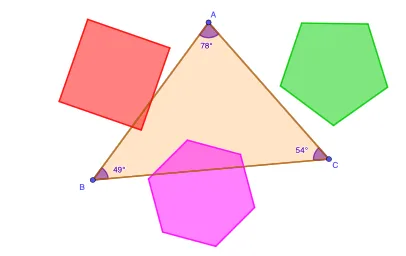
This example demonstrates how to construct and verify the smallest angle in a plane geometry setting by building candidate configurations and comparing their angle measures. The key concepts include angle construction and measurement, relationships within triangle/polygon configurations, and (where used in the construction) trigonometric ideas such as sine to describe or constrain the angles, reflecting an optimization-like task under given geometric conditions. Construction highlights: GeoGebra commands Segment, Polygon, and Angle are used to create essential segments, form polygon/triangle structures, and define angle objects (e.g., α, β, γ) for quantitative comparison. Supporting objects such as key points (A, B, C, D, E) and auxiliary constructed entities (lines/functions/parameters denoted by f, g, h, t1, c, etc.) organize the constraints, leading to multiple candidate angles (i, j, k, l, m, n, etc.) and identifying the one corresponding to the minimum. Suitable for advanced middle-school and early university learners, especially for lessons on geometric construction, angle measurement, and geometry–trigonometry integration.
GeoGebra Commands & Parameters
Segment(A, B) → fSegment(B, C) → gSegment(C, A) → hPolygon(A, B, C) → t1, c, a, bAngle(t1) → α, β, γPolygon(D, E, 4) → poly1, i, j, k, l, F, GPolygon(H, I, 5) → poly2, m, n, p, q, r, J, K, LPolygon(M, N, 6) → poly3, s, R, t, d, e, f_1, g_1, O, P, Q
AI Drawing Prompt Reference
On a plane, first draw a triangle with vertices A, B, and C and connect its three sides to form a complete triangular region. Then mark three corresponding angle measures inside the configuration and denote them as α, β, and γ so they can be compared. Next, build several polygon-based candidate arrangements: construct one polygon using points D and E together with an additional parameter, which yields multiple angle candidates; construct a second polygon using points H and I with another parameter, again producing several angle candidates; and finally construct a third polygon using points M and N with a third parameter to generate further angles to compare and identify the smallest among the candidates.
The prompt above was compiled from the original drawing commands and is for reference only.