
Geometric Construction of Sine and Cosine for 30n° Angles
Loading the math board and drawing, please wait…
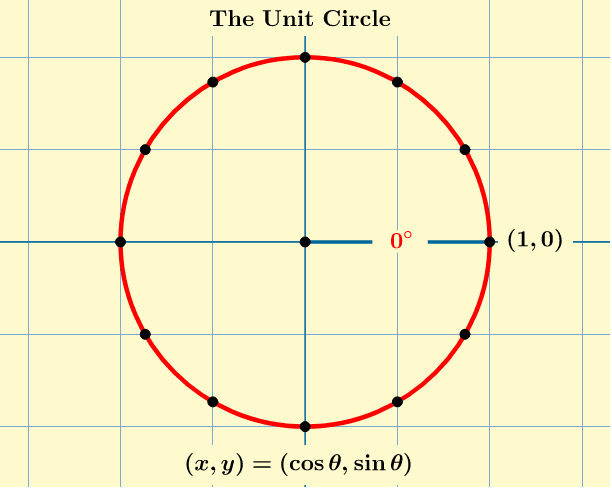
This example demonstrates the geometric representation of sine and cosine values for angles that are integer multiples of 30 degrees. Key concepts include trigonometric functions, unit circle properties, and sequence patterns. Construction utilizes GeoGebra commands such as Circle, Mirror, Segment, Polygon, and Angle to visualize the relationships. It is designed for high school students learning trigonometry or educators creating dynamic classroom demonstrations to illustrate special angle values and periodicity.
GeoGebra Commands & Parameters
Intersect(xAxis, yAxis) → APoint(xAxis) → BCircle(A, B) → cIntersect(c, f, 1) → CIntersect(c, f, 2) → DIntersect(c, g, 2) → EIntersect(c, g, 1) → FMirror(E, xAxis) → E'Mirror(F, xAxis) → F'Mirror(C, yAxis) → C'Mirror(D, yAxis) → D'Intersect(c, xAxis, 2) → GIntersect(c, yAxis, 2) → HIntersect(c, yAxis, 1) → ISegment(A, E) → jSegment(A, E') → kSegment(E, E') → lPolygon(A, C', C) → poly2, n, p, qPolygon(A, E', E) → poly1, e, a, e'Segment(G, C') → mPolygon(A, F, F') → poly4, f', a_3, f_1Polygon(D, D', A) → poly5, r, s, tSegment(A, B) → bSegment(A, H) → dSegment(G, A) → g_1Segment(A, I) → h_1Intersect(i, l) → JSegment(A, J) → i_1Angle(E, J, A) → αIntersect(h, p) → KSegment(K, A) → j_1Angle(C', K, A) → βIntersect(i, a_3) → LSegment(L, A) → k_1Angle(F', L, A) → γIntersect(h, r) → MSegment(A, M) → l_1Angle(D, M, A) → δPolygon(P, N, O, Q) → poly3, p_1, n_1, o, q_1Polygon(P_1, N_1, O_1, Q_1) → poly3_1, p_2, n_2, o_1, q_2Polygon(P_2, N_2, O_2, Q_2) → poly3_2, p_3, n_3, o_2, q_3Polygon(P_3, N_3, O_3, Q_3) → poly3_3, p_4, n_4, o_3, q_4Polygon(P_4, N_4, O_4, Q_4) → poly3_4, p_5, n_5, o_4, q_5Polygon(P_5, N_5, O_5, Q_5) → poly3_5, p_6, n_6, o_5, q_6Polygon(P_6, N_6, O_6, Q_6) → poly3_6, p_7, n_7, o_6, q_7Polygon(P_7, N_7, O_7, Q_7) → poly3_7, p_8, n_8, o_7, q_8Polygon(P_8, N_8, O_8, Q_8) → poly3_8, p_9, n_9, o_8, q_9Polygon(P_9, N_9, O_9, Q_9) → poly3_9, p_{10}, n_{10}, o_9, q_{10}Polygon(P_{10}, N_{10}, O_{10}, Q_{10}) → poly3_{10}, p_{11}, n_{11}, o_{10}, q_{11}Polygon(P_{11}, N_{11}, O_{11}, Q_{11}) → poly3_{11}, p_{12}, n_{12}, o_{11}, q_{12}