
Geometric Construction of an Isosceles Trapezoid
Loading the math board and drawing, please wait…
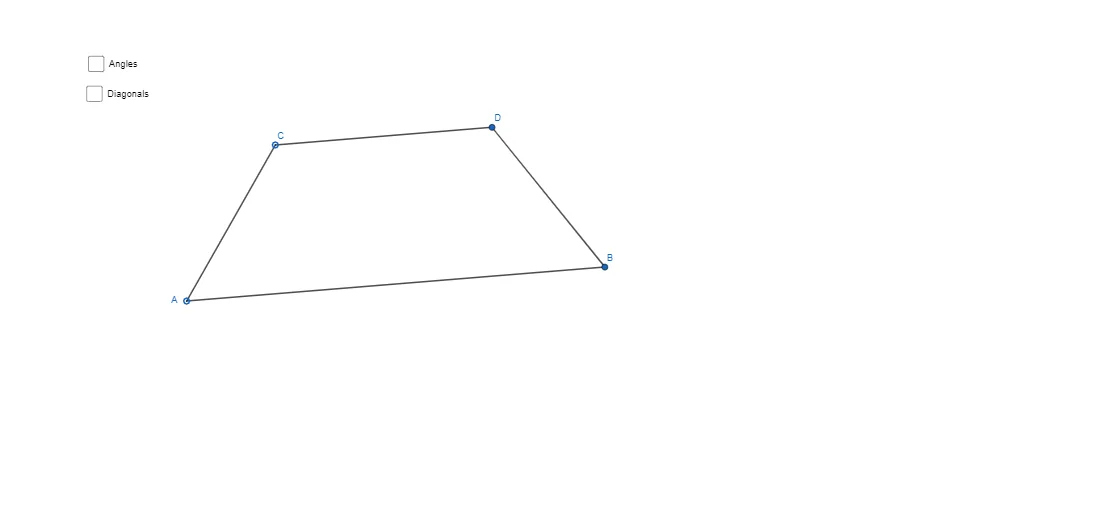
This example uses dynamic geometry to demonstrate the defining symmetry and angle properties of an isosceles trapezoid, and it leverages similar triangles to relate lengths and angles to the behavior of secant (cutting) lines. Key concepts include isosceles trapezoids, symmetry via reflection (mirror/axis), angle bisectors, similar triangles, and straight-line/secting-line configurations. The construction also highlights function-style relationships (e.g., power functions) to represent how certain measures can vary consistently with underlying parameters. Construction workflow: Segment is used to build trapezoid sides; Circle provides auxiliary circles to locate pivotal points; Line and Intersect compute intersections of lines; LineBisector introduces angle bisectors to enforce isosceles conditions; Mirror applies reflection to generate symmetric elements; Angle is employed to measure and confirm the critical angle relationships. The construction is built from multiple labeled points and geometric objects (lines and function-related elements) to support the similarity and angle checks. Suitable for middle and high school geometry instruction, contest geometry practice, and interactive visualization lessons.
GeoGebra Commands & Parameters
Segment(A, B) → fCircle(A, C) → cLine(C, f) → gSegment(A, C) → hLineBisector(A, B) → iMirror(C, i) → DSegment(C, D) → jSegment(D, B) → kAngle(B, A, C) → αAngle(A, C, D) → βAngle(C, D, B) → γAngle(D, B, A) → δSegment(A, D) → lSegment(C, B) → mAngle(B, A, D) → εAngle(D, A, C) → ζAngle(A, C, B) → ηAngle(B, C, D) → θAngle(C, D, A) → ιAngle(A, D, B) → κAngle(D, B, C) → λAngle(C, B, A) → μIntersect(l, m) → ESegment(A, E) → nSegment(E, D) → pSegment(E, C) → qSegment(E, B) → rAngle(A, E, B) → ν
AI Drawing Prompt Reference
Draw an isosceles trapezoid to demonstrate its symmetry and angle properties, using similar triangles to relate lengths and angles to the behavior of secant lines. Start by drawing the two parallel sides of the trapezoid, then use circles to locate key points and connect them with lines. Construct angle bisectors to enforce the isosceles conditions and generate symmetric elements via reflection. Measure and label all critical angles, find the intersection of the diagonals, and connect this point to the vertices, forming four new triangles with labeled angle relationships.
The prompt above was compiled from the original drawing commands and is for reference only.