
Geometric Construction for Cube Roots: Modeling the Cube-Root Relationship
Loading the math board and drawing, please wait…
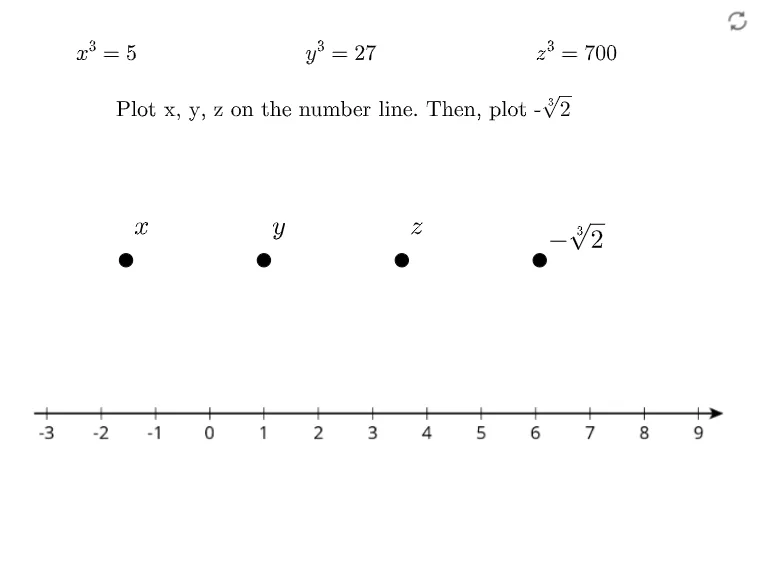
This example uses a geometric construction to demonstrate the cube-root idea as a clear number–geometry correspondence: quantities related to cubic relationships are represented as lengths/positions in a constructed figure, making the meaning and computation path of cube roots more intuitive. The key math concepts include cube roots (the inverse of cubing), proportional/length relationships, and geometric modeling connected to unit-circle style reasoning, along with parallelogram/rhombus-based constraints to build a visually verifiable structure. Construction-wise, the provided GeoGebra setup indicates multiple named points (A, B, C, D, E, F) together with a figure container (pic1) and several annotation texts (text1–text4) to guide the construction and highlight the correspondence between geometric elements and the cube-root relationship. Suitable for upper middle school to early high school students, especially for integrating algebra and geometry, as well as for exploratory classroom activities and math visualization practice.
GeoGebra Commands & Parameters
Point A(-12, 2)Point B(3, 2)Point C(-10, 6)Point D(-7, 6)Point E(-4, 6)Point F(-1, 6)
AI Drawing Prompt Reference
Draw a geometric figure with six points located at coordinates (-12, 2), (3, 2), (-10, 6), (-7, 6), (-4, 6), and (-1, 6), constructing a clear geometric structure to demonstrate the correspondence between cube roots and geometric lengths, with annotations explaining the connection between geometric elements and cube root calculations.
The prompt above was compiled from the original drawing commands and is for reference only.