
Geometric Construction Demonstrating Pythagoras' Theorem
Loading the math board and drawing, please wait…
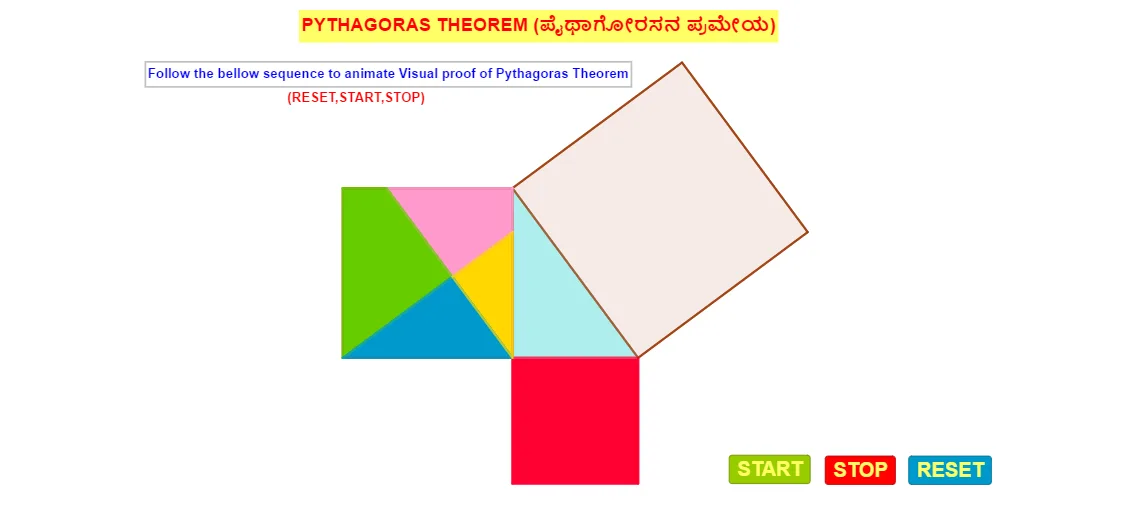
This example uses interactive geometric construction to visually demonstrate the relationship in a right triangle: the square of the hypotenuse equals the sum of the squares of the two legs. It centers on Pythagoras' Theorem and its geometric interpretation via areas/side-length squares, along with right-triangle geometry and precise point placement using intersections of lines and circles. The construction leverages GeoGebra commands such as Intersect and Point to generate key vertices, Line and Circle to define supporting curves and constraint geometry, and Polygon to build comparable square/region-like shapes whose sizes reflect the squared lengths. Vector and Translate are used to implement geometric transformations (copying and shifting constructed parts), while additional constructed objects and parameters (e.g., control parameters and multiple polygons poly1, poly2, poly3) support dynamic updates as the triangle changes. Suitable for middle-school geometry instruction, interactive teaching demonstrations, and learners practicing theorem-based construction.
GeoGebra Commands & Parameters
Intersect(xAxis, yAxis) → APoint(xAxis) → BPoint(yAxis) → CPolygon(A, B, C) → t1, c, a, bPolygon(C, B, 4) → poly1, f, g, h, i, D, EPolygon(B, A, 4) → poly2, j, k, l, m, F, GPolygon(A, C, 4) → poly3, n, p, q, r, H, ILine(A, h) → sLine(I, i) → tIntersect(s, p) → JIntersect(t, b) → KIntersect(s, t) → LPolygon(A, K, L) → t2, l_1, a_1, k_1Polygon(L, K, C, J) → q1, l_2, k_2, c_1, j_1Polygon(L, J, H, I) → q2, l_3, j_2, h_1, i_1Polygon(L, I, A) → t3, a_2, l_4, i_2Vector(L, M) → uVector(L, N) → vVector(L, O) → wTranslate(L, u) → L'Translate(K, u) → K'Translate(C, u) → C'Translate(J, u) → J'Polygon(L', K', C', J') → q1', l', k', c', j'Translate(L, v) → L'_1Translate(J, v) → J'_1Translate(H, v) → H'Translate(I, v) → I'Polygon(L'_1, J'_1, H', I') → q2', l'_1, j'_1, h', i'Translate(L, w) → L'_2Translate(I, w) → I'_1Translate(A, w) → A'Polygon(L'_2, I'_1, A') → t3', a', l'_2, i'_1Vector(L, P) → u_1Translate(A, u_1) → A'_1Translate(K, u_1) → K'_1Translate(L, u_1) → L'_3Polygon(A'_1, K'_1, L'_3) → t2', l'_3, a'_1, k'_1Circle(B, Segment[J, L]) → d_1Intersect(d_1, a) → Q,Vector(F, R) → v_1Translate(poly2, v_1) → poly2'
AI Drawing Prompt Reference
This is a geometric figure demonstrating Pythagoras' Theorem. The figure features a right triangle with legs labeled a and b, and hypotenuse labeled c. Three squares are included, each with side lengths a, b, and c, labeled poly1, poly2, and poly3. These squares are connected by line segments to form a symmetric layout. The figure also includes auxiliary points such as A, B, and C to define the triangle's vertices. The overall figure is a static geometric construction suitable for geometry teaching demonstrations.
The prompt above was compiled from the original drawing commands and is for reference only.