
Geogebra Triangular Prism Demo
Loading the math board and drawing, please wait…
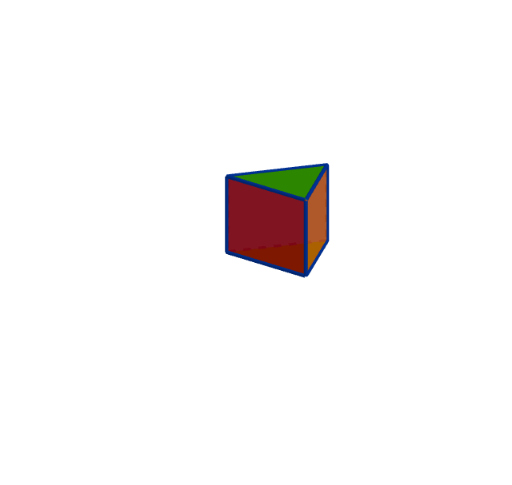
This example demonstrates the construction and properties of a triangular prism using GeoGebra. It involves core mathematical concepts like prism, congruence, function graph, differential equation, calculus, and special points. Key GeoGebra commands and objects used include Intersect, Point, Polygon, Prism, Net, and Rotate, as outlined in the construction summary. Suitable for high school and above, it illustrates applications in solid geometry, functions, and calculus.
GeoGebra Commands & Parameters
Intersect(xAxis, yAxis) → APoint(xAxis) → BPolygon(A, B, 3) → poly1, a, b, c, CPrism(poly1, 5) → d, D, edgeCF, edgeDE, edgeEF, edgeDF, E, F, faceABED, faceBCFE, faceACFD, faceDEF, edgeAD, edgeBENet(d, e) → f, G, P, faceGHI, faceGHKJ, faceHIML, faceGINO, faceJKP, edgeGH, edgeHI, edgeGI, edgeGJ, H, edgeJK, edgeHK, edgeHL, edgeLM, edgeIM, edgeIN, edgeNO, edgeGO, edgeKP, edgeJP, I, J, K, L, M, N, OPoint(Circle[Q, edgeGI]) → RRotate(R + (edgeGO, 0), Angle[(0, 5)] + Angle[R - Q] - Angle[(6.53, 0)], R) → SRotate(S + (edgeNO, 0), Angle[(-6.53, 0)] + Angle[S - R] - Angle[(0, 5)], S) → TPolygon(Q, R, S, T) → poly2, q, r, s, tRotate(Q, (-α)) → Q'Rotate(R, (-α)) → R'Rotate(S, (-α)) → S'Rotate(T, (-α)) → T'Rotate(Q, α) → Q'_1Rotate(R, α) → R'_1Rotate(S, α) → S'_1Rotate(T, α) → T'_1Polygon(Q'_1, R'_1, S'_1, T'_1) → poly2', q'_1, r'_1, s'_1, t'_1Point(Circle[U, edgeHI]) → VRotate(V + (edgeIM, 0), Angle[(0, 5)] + Angle[V - U] - Angle[(6.53, 0)], V) → WRotate(W + (edgeLM, 0), Angle[(-6.53, 0)] + Angle[W - V] - Angle[(0, 5)], W) → ZPolygon(U, V, W, Z) → poly3, u, v, w, z_1Rotate(U, (-α)) → U'Rotate(V, (-α)) → V'Rotate(W, (-α)) → W'Rotate(Z, (-α)) → Z'Rotate(U, (-α), B) → U'_1Rotate(V, (-α), B) → V'_1Rotate(W, (-α), B) → W'_1Rotate(Z, (-α), B) → Z'_1Polygon(U'_1, V'_1, W'_1, Z'_1) → poly3', u'_1, v'_1, w'_1, z'_1
AI Drawing Prompt Reference
Draw a triangular prism with an equilateral triangle base and height 5. Unfold the prism into a net consisting of three rectangular side faces and one triangular base. On one side face, pick a point and rotate it along the edges of that face to form a new quadrilateral. Repeat a similar operation on another side face to create another quadrilateral. Finally, rotate these two new quadrilaterals around the prism's vertices by a certain angle to obtain rotated versions, keeping both the original net and the rotated shapes to illustrate the geometric transformation of the prism.
The prompt above was compiled from the original drawing commands and is for reference only.