
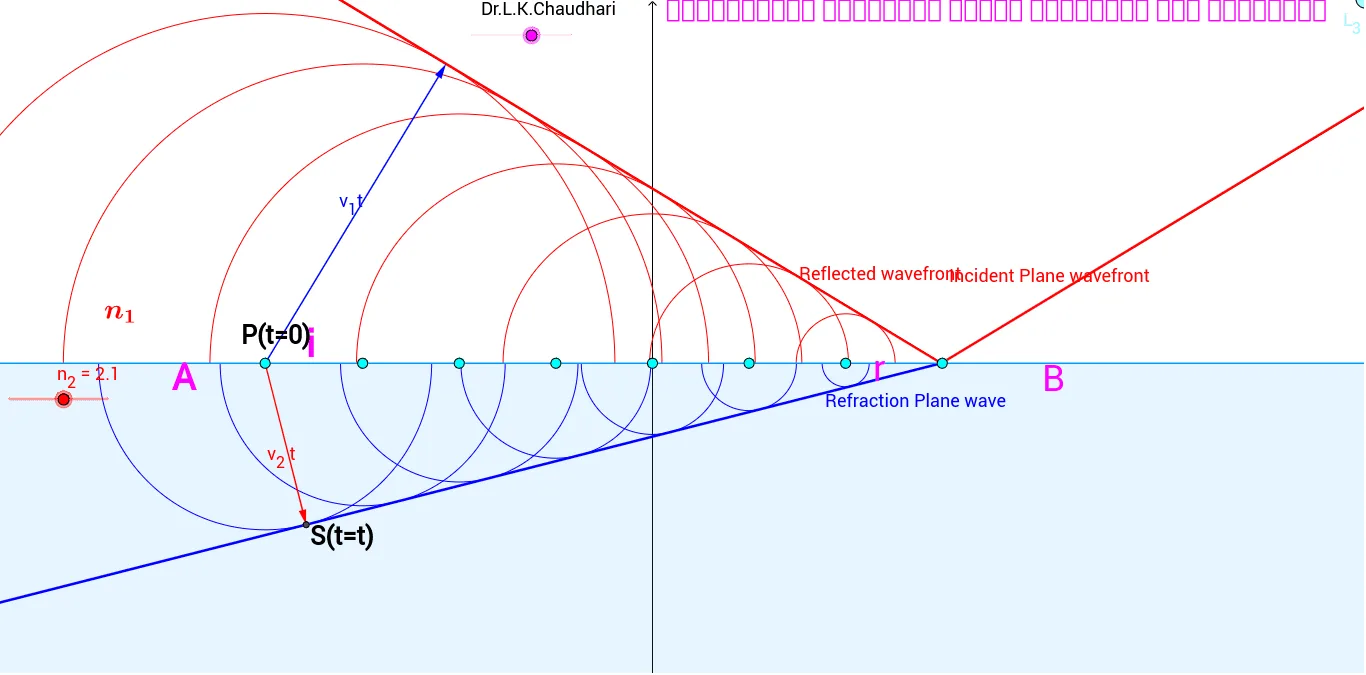
Geogebra Demonstration of Reflection & Refraction by Huygens Principle
Loading the math board and drawing, please wait…
This example dynamically demonstrates the principles of light reflection and refraction using GeoGebra. It involves core mathematical concepts such as the law of reflection, Snell's law, angle measurement, and vector operations. Key GeoGebra commands used include Intersect, Line, OrthogonalLine, Point, Angle, Ray, Rotate, and Circle. Suitable for high school physics and mathematics education to help students visually understand optical principles.
GeoGebra Commands & Parameters
Intersect(xAxis, yAxis) → BLine(A_3, B) → aOrthogonalLine(B, xAxis) → bPoint(b) → CAngle(C, B, A_3) → αOrthogonalLine(D, a) → cCorner(1) → EOrthogonalLine(E, xAxis) → dIntersect(c, d) → FIntersect(xAxis, c) → GRay(B, A_3) → fOrthogonalLine(G, f) → gOrthogonalLine(G, f) → hPoint(h) → IRay(G, I) → iPoint(xAxis) → ARotate(U, (45° * β_1), B) → U'Point(i) → KPoint(xAxis) → JPoint(xAxis) → OPoint(xAxis) → P_3Rotate(U, β_1, B) → U'_1Angle(U, B, U'_1) → βRay(B, U'_1) → jLine(G, j) → eOrthogonalLine(G, e) → kPoint(k) → LRay(G, L) → lRotate(M, π / 2 - α, B) → M'Angle(M, B, M') → δLine(B, M') → pOrthogonalLine(G, p) → qPoint(q) → NRay(G, N) → rOrthogonalLine(A, l) → sIntersect(s, l) → QCircle(A, Q) → c_1Intersect(c_1, xAxis) → R, SCircleArc(A, R, S) → d_1OrthogonalLine(A, r) → a_1Intersect(r, a_1) → TCircle(A, T) → e_1Intersect(e_1, xAxis) → V, WCircleArc(A, W, V) → f_1Ray(B, M') → b_1OrthogonalLine(O, l) → g_1Intersect(g_1, l) → A_1Circle(O, A_1) → h_1Intersect(h_1, xAxis) → B_1, C_1CircleArc(O, B_1, C_1) → k_1OrthogonalLine(P_3, l) → i_1Intersect(l, i_1) → D_1Circle(P_3, D_1) → p_1Intersect(p_1, xAxis) → E_1, F_1CircleArc(P_3, E_1, F_1) → q_1Point(xAxis) → G_1OrthogonalLine(G_1, l) → j_1Intersect(j_1, l) → H_1Circle(G_1, H_1) → r_1Intersect(r_1, xAxis) → I_1, J_1CircleArc(G_1, I_1, J_1) → s_1Point(xAxis) → K_1OrthogonalLine(K_1, l) → l_1Intersect(l, l_1) → L_1Circle(K_1, L_1) → t_1Intersect(t_1, xAxis) → M_1, N_1CircleArc(K_1, M_1, N_1) → c_2Intersect(j, l) → O_1Circle(B, O_1) → d_2Intersect(d_2, xAxis) → P_1, Q_1CircleArc(B, P_1, Q_1) → e_2Point(xAxis) → R_1OrthogonalLine(R_1, l) → m_1Intersect(m_1, l) → S_1Circle(R_1, S_1) → f_2Intersect(f_2, xAxis) → T_1, U_1CircleArc(R_1, T_1, U_1) → g_2Point(xAxis) → V_1OrthogonalLine(V_1, l) → n_1Intersect(l, n_1) → W_1Circle(V_1, W_1) → h_2Point(xAxis) → B_2OrthogonalLine(B_2, l) → a_2Intersect(l, a_2) → C_2Circle(B_2, C_2) → p_2Intersect(p_2, xAxis) → D_2, E_2CircleArc(B_2, D_2, E_2) → q_2OrthogonalLine(O, r) → b_2Intersect(r, b_2) → F_2Circle(O, F_2) → r_2Intersect(r_2, xAxis) → G_2, H_2CircleArc(O, H_2, G_2) → s_2OrthogonalLine(P_3, r) → i_2Intersect(r, i_2) → I_2Circle(P_3, I_2) → t_2Intersect(t_2, xAxis) → J_2, K_2CircleArc(P_3, K_2, J_2) → c_3OrthogonalLine(G_1, r) → j_2Intersect(j_2, r) → L_2Circle(G_1, L_2) → d_3Intersect(d_3, xAxis) → M_2, N_2CircleArc(G_1, N_2, M_2) → e_3Intersect(b_1, r) → O_2Circle(B, O_2) → f_3Intersect(f_3, xAxis) → P_2, Q_2CircleArc(B, Q_2, P_2) → g_3OrthogonalLine(K_1, r) → l_2Intersect(l_2, r) → R_2Circle(K_1, R_2) → h_3Intersect(h_3, xAxis) → S_2, T_2CircleArc(K_1, T_2, S_2) → k_3OrthogonalLine(R_1, r) → m_2Intersect(m_2, r) → U_2Circle(R_1, U_2) → p_3Intersect(p_3, xAxis) → V_2, W_2CircleArc(R_1, W_2, V_2) → q_3OrthogonalLine(V_1, r) → n_3Point(j) → C_3Point(xAxis) → E_3Polygon(I_3, G_3, H_3, F_3) → polígono1, i_3, g_4, h_4, f_4OrthogonalLine(A_3, b) → b_3Intersect(b_3, b_1) → D_3Intersect(c, i) → N_3Line(Corner[4], Corner[3]) → k_2Intersect(i, k_2) → Z_1Corner(4) → Z_2Intersect(f_1, r, 1) → HVector(A, H) → v_1tIntersect(d_1, l, 1) → PVector(A, P) → u
AI Drawing Prompt Reference
Draw a diagram illustrating light reflection and refraction. Start by drawing the intersection point B of the x-axis and y-axis. Then, draw a line a from point A_3 to B. Draw a perpendicular line b from B to the x-axis and take point C on b. Measure the angle α between points C, B, and A_3. Draw a perpendicular line c from B to line a and take point D on c. Draw a corner point E on the x-axis and a perpendicular line d from E to the x-axis, intersecting c at point F. Draw a ray f from B to A_3 and a perpendicular line g from G to f, intersecting d at point G. Draw a perpendicular line h from G to f and take point I. Draw a ray i from G to I. Draw a point A on the x-axis and rotate point U 45° * β_1 around B to get U'. Draw a ray j from B to U' and intersect it with f at point H. Draw a line e from G to H and intersect it with f at point K. Draw a perpendicular line l from G to e and take point M. Draw a ray m from B to M and intersect it with f at point N. Draw a line n from A to N and intersect it with f at point P. Draw a circle c_1 centered at A passing through P and intersecting the x-axis at points R and S. Draw an arc d_1 from A to R and S. Draw a perpendicular line s from A to l and intersect it with l at point Q. Draw a circle c_2 centered at A passing through Q and intersecting the x-axis at points V and W. Draw an arc f_1 from A to V and W. Draw a ray b_1 from B to M' and intersect it with f at point O. Draw a perpendicular line g_1 from O to l and intersect it with l at point P_1. Draw a circle h_1 centered at O passing through P_1 and intersecting the x-axis at points R_1 and S_1. Draw an arc j_1 from O to R_1 and S_1.
The prompt above was compiled from the original drawing commands and is for reference only.