
Generalized Spiral: Exploring Mathematical Beauty of Rotation and Angles
Loading the math board and drawing, please wait…
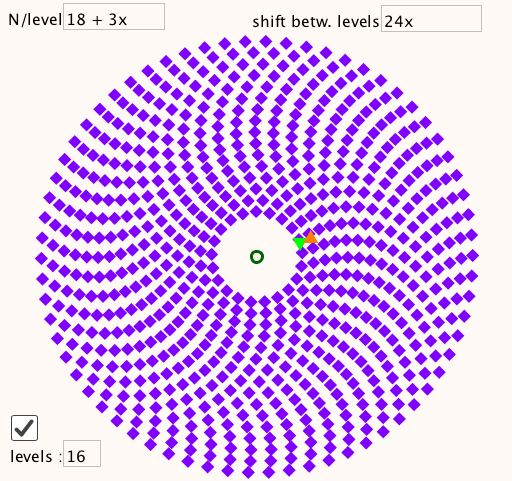
This example demonstrates the construction of a generalized spiral, highlighting the relationship between rotation, angles, and functions. Key mathematical concepts include rotational symmetry, angle variation, and spiral trajectories. Construction involves using GeoGebra commands like Textfield, Point, and Sequence to create the spiral. Suitable for high school students or math enthusiasts to understand geometric transformations and dynamic changes in function graphs.
GeoGebra Commands & Parameters
Textfield(levels) → InputBox3Point(Ray[B + (1 / levels * (A - B)), B]) → CTextfield(f) → InputBox1Textfield(g) → InputBox2Sequence(Sequence[Rotate[B + ((j - 1) * (C - B)), g(j) + ((i * 360) * ° / f(j)), A], i, 1, f(j)], j, 1, levels) → list1
AI Drawing Prompt Reference
Draw a generalized spiral composed of multiple levels. Start with an input for the number of levels)Skip. Define a ray and place a point on it proportionally to the level count, creating a dynamic reference point. Add two function inputs: one controls the rotation angle, the other controls the number of iterations per level. For each level, rotate the reference point around a fixed center repeatedly, with the angle increment determined by the first function, and add an overall rotation offset that varies with the level index. This generates a sequence of rotated points per level, forming a spiral pattern that illustrates the interplay of rotation and angle functions.
The prompt above was compiled from the original drawing commands and is for reference only.