
From Sphere to Cube and Back: 3D Morphing and Symmetry
Loading the math board and drawing, please wait…
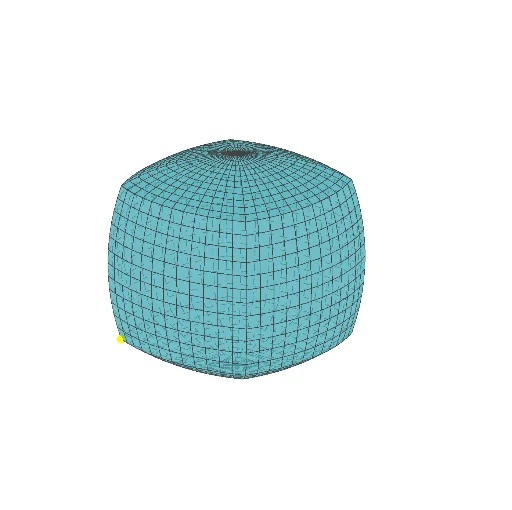
① This example demonstrates a dynamic geometric transformation where a sphere morphs continuously into a cube and then back, illustrating topological and geometric changes between 3D shapes. ② Core mathematical concepts include solid geometry of spheres and cubes, parametric surfaces, symmetry, and using inequalities to define 3D regions; it also involves geometric transformations such as rotation and reflection. ③ Construction highlights: uses GeoGebra commands Cube and Sphere to create base solids, Surface and CurveCartesian for parametric surfaces, Rotate and Mirror for transformations, Polygon and Midpoint for auxiliary faces and centers, Angle and Distance for measurements, Intersect for intersections, Centroid for centroid calculation, and sliders (implicit in parameters) to control the morphing. ④ Suitable for high school to university levels in solid geometry, 3D modeling, or mathematical visualization, and for exploring continuous mappings and symmetry between polyhedra and curved surfaces.
GeoGebra Commands & Parameters
Angle(A) → αDistance((0, 0), A) → RRotate(A, π / 2, (0, 0)) → A'CurveCartesian((R * cos(t)), (R * sin(t)), 0, t, α, α + π / 2) → aPolygon(A, A', 4) → pol1, f, g, h_1, i, B, CMidpoint(f) → FDistance(E, F) → hPoint(Circle[A', Distance[A, A'], Segment[A, A']]) → GCube(A, A', G) → cub, H, caraGHLK, caraIJKL, arestaAH, arestaAA', arestaA'G, arestaGH, arestaAI, arestaHL, arestaIL, arestaIJ, I, arestaA'J, arestaJK, arestaGK, arestaKL, J, K, L, caraAA'GH, caraAHLI, caraAA'JI, caraA'GKJMidpoint(A', L) → MDistance(A, M) → h'CurveCartesian(x(M) + (h' * cos(t)), y(M), z(M) + (h' * sin(t)), t, 0, (2 * π)) → eAngle(N, M, O) → βCurveCartesian(x(M) + (h' * cos(t)), y(M), z(M) + (h' * sin(t)), t, (2 * π) - β, (3 * π / 2)) → k_0Rotate(k_0, α - π, zAxis) → k'Sphere(M, A) → lSurface(k', π / 2, zAxis) → s_2CurveCartesian(AA + (k * (AA' - AA)), k, 0, 1) → nSurface((k * n(t)), k, 0, 1, t, 0, 1) → s_1Surface((s * s_1(k, t)) + ((1 - s) * s_2((c1 * k) + c2, (c3 * t) + c4)), k, 0, 1, t, 0, 1) → cRotate(c, π / 2, zAxis) → c_1Rotate(c, π, zAxis) → c_2Rotate(c, (3 * π / 2), zAxis) → c_3Mirror(c, pp) → c_4Mirror(c_1, pp) → c_5Mirror(c_2, pp) → c_6Mirror(c_3, pp) → c_7Midpoint(i) → PMidpoint(f) → QMidpoint(h_1) → SCentroid(caraAHLI) → UCentroid(caraA'GKJ) → VIntersect(zAxis, l) → W, ZMirror(a, pp) → a'Rotate(e, α - π, zAxis) → e'Angle(Z, M, I) → γCurveCartesian(e'(t), t, π / 2 + γ, (3 * π / 2) - γ) → oSurface(o, π / 2, zAxis) → s_3CurveCartesian(I + (k * (A - I)), k, 0, 1) → pCurveCartesian(J + (k * (A' - J)), k, 0, 1) → qSurface((k * q(t)) + ((1 - k) * p(t)), k, 0, 1, t, 0, 1) → s_4Surface((s * s_4(k, t)) + ((1 - s) * s_3((c5 * t) + c6, (c7 * k) + c8)), k, 0, 1, t, 0, 1) → dRotate(d, π / 2, zAxis) → d_1Rotate(d, (2 * π / 2), zAxis) → d_2Rotate(d, (3 * π / 2), zAxis) → d_3
AI Drawing Prompt Reference
Create a continuous 3D morphing shape that transforms from a sphere into a cube and back. Start with a sphere centered at the origin, and construct an inscribed cube using three points on the sphere. Use parametric surfaces to smoothly interpolate between the sphere and cube, forming a dynamic morphing surface. Rotate this surface around the vertical axis three times to create four symmetric copies, then mirror each copy to obtain eight symmetric parts. Additionally, construct auxiliary curves and surfaces connecting face centers and vertices of the cube, and add rotationally symmetric surface patches. Combine all elements into a highly symmetric complex 3D form that illustrates topological transformation between geometric solids.
The prompt above was compiled from the original drawing commands and is for reference only.