
Fractions of Circles: Sector Division and Rotation
Loading the math board and drawing, please wait…
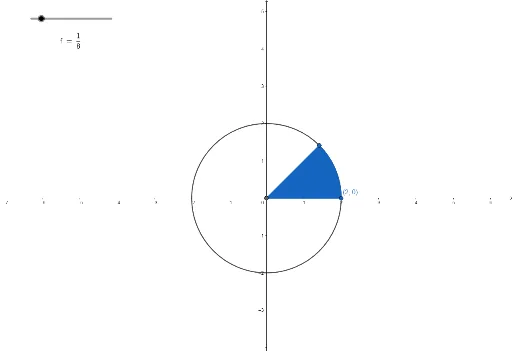
① This GeoGebra example visually demonstrates how a circle can be divided into fractional parts using sectors, rotation, and subtraction, showing fractions like 1/2, 1/3, etc. ② Core mathematical concepts include fractions of a circle, sector area, central angle, rotational symmetry, and geometric subtraction (e.g., removing a sector from a full circle). ③ Construction highlights: using GeoGebra commands Intersect, Point, Circle, Rotate, Angle, CircleSector, and LaTeX; key objects include center A, point B on the circle, circle c, parameter n (number of divisions), rotated point B', angle α, sector d, and text2 for labeling. ④ This is ideal for middle and high school students to explore circle geometry, fraction concepts, and transformations interactively, and for teachers to use in classroom demonstrations or student-led investigations.
GeoGebra Commands & Parameters
Intersect(xAxis, yAxis) → APoint(xAxis) → BCircle(A, B) → cRotate(B, n°, A) → B'Angle(B, A, B') → αCircleSector(A, B, B') → dLaTeX(f, true, true) → text2
AI Drawing Prompt Reference
Draw a circle with its center at the origin and a point on the positive x-axis. Use a slider to control a rotation angle, rotating this point around the center by that angle to get a second point on the circle. Connect the center to both points with radii, and fill the sector between them. Label the angle inside the sector and display text showing the fraction of the circle this sector represents (e.g., 1/2, 1/3). The whole figure shows how a circle can be divided into equal parts, with the rotation angle adjustable.
The prompt above was compiled from the original drawing commands and is for reference only.