
Fraction Subtraction Demo by sonom
Loading the math board and drawing, please wait…
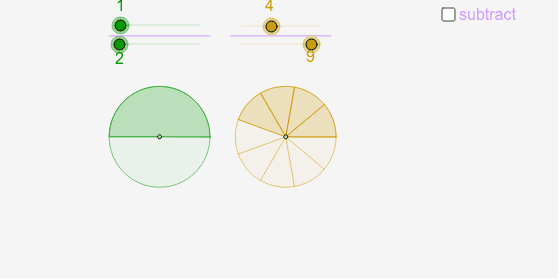
This example visually demonstrates the subtraction of two proper fractions, covering core concepts like proper fractions, least common multiple (LCM), equivalent fractions, and subtraction rules. It utilizes GeoGebra commands such as Circle, Point, LCM, Sequence, Midpoint, If, Vector, Translate, GCD, and Segment for construction. Suitable for middle school students or classroom presentations.
GeoGebra Commands & Parameters
Circle(A_1, r) → cPoint(c) → BCircle(A_2, r) → dLCM(denominator_1, denominator_2) → equivalentdenominatorSequence(Segment[A_2, Rotate[C_2, r°, A_2]], r, 0, 360, 360 / denominator_2) → PIEALL_2Sequence(Segment[A_1, Rotate[C_1, r°, A_1]], r, 360 / denominator_1, 360, 360 / denominator_1) → PIEALL_1Sequence(CircleSector[A_1, Rotate[C_1, r°, A_1], Rotate[C_1, (r + 360 / denominator_1)°, A_1]], r, 0, 360 / denominator_1 * numerator_1 - 360 / denominator_1, 360 / denominator_1) → PIESECTION_1Sequence(Segment[A_1, Rotate[C_1, r°, A_1]], r, 0, 360, 360 / equivalentdenominator) → PIEALL_{1E}Sequence(Segment[A_2, Rotate[C_2, r°, A_2]], r, 0, 360, 360 / equivalentdenominator) → PIEALL_{2E}Sequence(CircleSector[A_1, Rotate[C_1, r°, A_1], Rotate[C_1, (r + 360 / equivalentdenominator)°, A_1]], r, 0, 360 / equivalentdenominator * numerator_{1E} - 360 / equivalentdenominator, 360 / equivalentdenominator) → PIESECTION_{1E}Midpoint(A_1, A_2) → A_{mid}Circle(A_1, r) → PIESECTION_{1whole}Circle(A_2, r) → PIESECTION_{2whole}If(¬subtractfractions, "+", "−") → addsign2Sequence(CircleSector[A_2, Rotate[C_2, r°, A_2], Rotate[C_2, (r + 360 / denominator_2)°, A_2]], r, 0, 360 / denominator_2 * numerator_2 - 360 / denominator_2, 360 / denominator_2) → PIESECTION_{2subtract}Sequence(CircleSector[A_2, Rotate[C_2, r°, A_2], Rotate[C_2, (r + 360 / equivalentdenominator)°, A_2]], r, 0, 360 / equivalentdenominator * numerator_{2E} - 360 / equivalentdenominator, 360 / equivalentdenominator) → PIESECTION_{2Esubtract}If(shiftleftright ≟ 2.5 * r, 1, 0) → triggerSequence(CircleSector[A_2, Rotate[C_2, r°, A_2], Rotate[C_2, (r + 360 / equivalentdenominator)°, A_2]], r, numerator_{2E} * 360 / equivalentdenominator, 360 / equivalentdenominator * (numerator_{1E} - 1), 360 / equivalentdenominator) → PIESECTION_{finalsubtract1}Vector(A_2, A_{2end1}) → uTranslate(PIESECTION_{finalsubtract1}, Vector[detachpie * u]) → PIESECTION_{finalsubtract2}Vector(A_2, A_{2end2}) → vCircle(A_2, r) → PIESECTION_{whole1}Sequence(CircleSector[A_2, Rotate[C_2, r°, A_2], Rotate[C_2, (r + 360 / equivalentdenominator)°, A_2]], r, (equivalentdenominator - numerator_{2E}) * 360 / equivalentdenominator, 360 / equivalentdenominator * (mixednumerator + equivalentdenominator - numerator_{2E} - 1), 360 / equivalentdenominator) → PIESECTION_{part1}Circle(A_2, r) → PIESECTION_{whole2}GCD(equivalentnumerator, equivalentdenominator) → ResultGCDGCD(abs(equivalentnumerator_{subtract}), equivalentdenominator) → ResultGCD_{subtract}If(abs(equivalentnumerator) < equivalentdenominator, If[ResultGCD ≟ 1, 4.5 * r, 3.5 * r], If[ResultGCD ≟ 1, 0, -2 * r]) → x_{textEquivalentsign3}If(ResultGCD ≟ 1, -0.25 * r, If[equivalentnumerator < equivalentdenominator, 5 * r, -0.25 * r]) → x_{textposition2}Sequence(CircleSector[A_2, Rotate[C_2, r°, A_2], Rotate[C_2, (r + 360 / equivalentdenominator)°, A_2]], r, numerator_{1E} * 360 / equivalentdenominator, 360 / equivalentdenominator * (numerator_{2E} - 1), 360 / equivalentdenominator) → PIESECTION_{negativefinalsubtract1}Vector(A_2, A_{2end3}) → wTranslate(PIESECTION_{negativefinalsubtract1}, Vector[detachpie * v]) → PIESECTION_{negativefinalsubtract2}Segment(A, C) → aSegment(D, E) → b
AI Drawing Prompt Reference
Draw two circles to represent two fractions. First, draw the first circle to represent the first fraction, then draw the second circle to represent the second fraction. On the second circle, draw two segments representing the numerator and denominator of the second fraction. Next, on the first circle, draw a segment representing the numerator of the first fraction. Then, calculate the least common multiple of the two denominators to adjust the second circle's segments to align with the first circle. Finally, based on the difference between the two fractions, subtract the corresponding segments from the second circle to demonstrate the subtraction process.
The prompt above was compiled from the original drawing commands and is for reference only.