
Fraction Division: Geometric Intuition for a÷b (Partitive)
Loading the math board and drawing, please wait…
In collections
Fraction Division (2018)
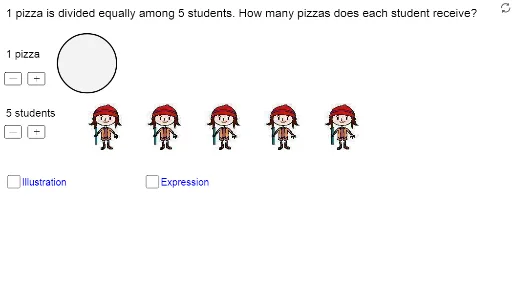
This GeoGebra example demonstrates partitive division, helping students intuitively understand that a÷b equals a/b by visualizing how to divide a quantity into b equal parts. Key mathematical concepts include the two meanings of division (sharing vs. grouping) and the relationship between division and fractions. Construction details: Uses Point commands to create key points, Segment commands to draw lines representing the unit and quantities to be divided, Polygon commands to construct area models visualizing the 'dividing a into b parts' process, Sequence commands to generate equal division points, Translate commands to animate the distribution, and GCD commands to ensure integer division points. Suitable for elementary school students (grades 3-5) learning fraction division concepts, and as a teaching tool for teachers to demonstrate the meaning of division.
GeoGebra Commands & Parameters
Point(Segment[(x(D) + 2 / 5, y(D)), (x(D) + 1, y(D))]) → SSegment(A, (x(A) + 1, y(A))) → l1Point(Segment[(x(A) + 1 / 5, y(A)), (x(A) + 1, y(A))]) → PSegment(B, (x(B) + 1, y(B))) → l2Point(Segment[(x(B) + 2 / 6, y(B)), (x(B) + 1, y(B))]) → QPoint(Segment[(x(C) + 1 / 6 - 0.005, y(C)), (x(Q) - 1 / 6, y(C))]) → RSegment(C, (x(C) + 1, y(C))) → l3Sequence(Circle[((2.5 * (i - 1)), 0), 1], i, 1, a) → list1Sequence(Sequence[CircleSector[((f * sin((((2 * k) - 1) * θ / 2))) + (2.5 * (m - 1)), (f * cos((((2 * k) - 1) * θ / 2)))), ((f * sin((((2 * k) - 1) * θ / 2))) + sin((k * θ)) + (2.5 * (m - 1)), (f * cos((((2 * k) - 1) * θ / 2))) + cos((k * θ))), ((f * sin((((2 * k) - 1) * θ / 2))) + sin(((k - 1) * θ)) + (2.5 * (m - 1)), (f * cos((((2 * k) - 1) * θ / 2))) + cos(((k - 1) * θ)))], k, 1, b], m, 1, a) → list4Sequence(Segment[((2.5 * a), 0), ((2.5 * a) - sin((j * θ)), cos((j * θ)))], j, 1, c - 1) → list2Segment(D, (x(D) + 1, y(D))) → l4Polygon((0.016528925619834656, -3), (1.2165289256198346, -3), (1.2165289256198346, -1.3), (0.016528925619834656, -1.3)) → poly1, e, g, h, iGCD(a, d) → kSegment(A, P) → jSegment(C, R) → lSegment(B, Q) → mSegment(D, S) → nSequence(Sequence[CircleSector[(((-f) * sin((((2 * k) - 1) * θ / 2))) + (2.5 * (m - 1)), (f * cos((((2 * k) - 1) * θ / 2)))), (((-f) * sin((((2 * k) - 1) * θ / 2))) - sin(((k - 1) * θ)) + (2.5 * (m - 1)), (f * cos((((2 * k) - 1) * θ / 2))) + cos(((k - 1) * θ))), (((-f) * sin((((2 * k) - 1) * θ / 2))) - sin((k * θ)) + (2.5 * (m - 1)), (f * cos((((2 * k) - 1) * θ / 2))) + cos((k * θ)))], k, 1, 1], m, 1, a) → list6Translate(pic5, Vector[I, J]) → pic6
AI Drawing Prompt Reference
Draw a geometric figure to illustrate the concept of fraction division, including two points A and B representing the dividend and divisor respectively. Connect A and B to the unit line with line segments l1 and l2, and use points P, Q, and R to divide the line segments into equal parts, showing how to divide A into B parts. Use circles and sector areas to model the process of dividing A into B parts, and finally demonstrate the distribution of equal division points through a translation animation.
The prompt above was compiled from the original drawing commands and is for reference only.